
Introduction to Agentic AI
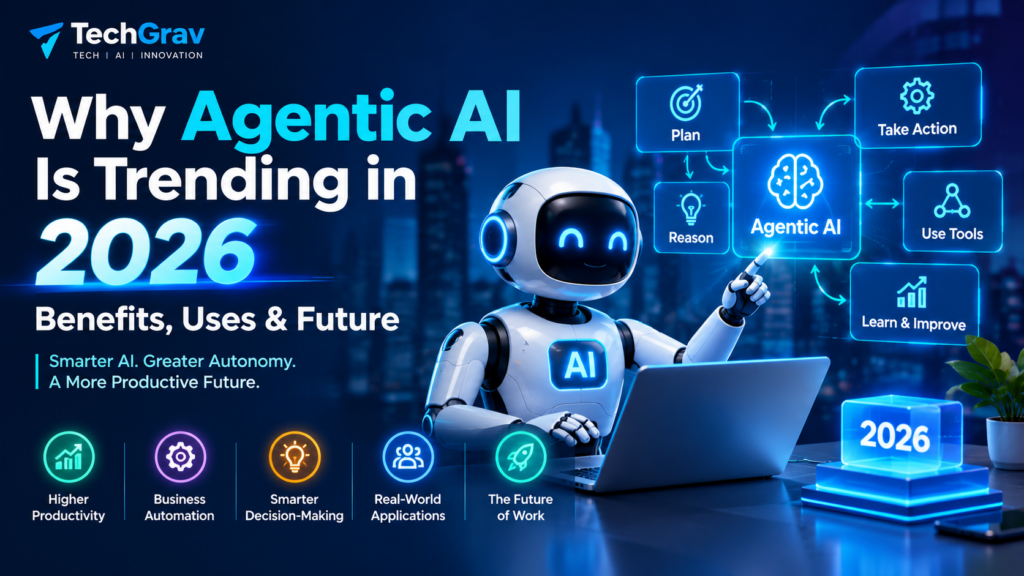
Artificial intelligence has evolved significantly, from simple chatbots to advanced systems capable of generating content, analyzing information, and assisting with complex tasks. In 2026, one technology attracting growing attention is Agentic AI.
Unlike traditional AI tools that primarily respond to prompts, Agentic AI can plan tasks, use digital tools, make decisions, and take actions toward specific goals. Depending on its design and permissions, it can complete multiple steps with limited human intervention.
Businesses are Exploring Agentic AI to improve productivity, automate workflows, reduce repetitive work, and support faster decision-making. At the same time, developers and everyday users are discovering new ways to use AI beyond simple conversations.
But what exactly is Agentic AI, why is it gaining so much attention in 2026, and how could it transform the future of technology?
Table of Contents
What is Agentic AI?
Agentic AI refers to artificial intelligence systems that can pursue defined goals by planning, reasoning, using tools, and executing actions with varying levels of autonomy.
Traditional AI often focuses on answering questions, generating content, or making predictions. Agentic AI extends these capabilities by connecting them into a workflow designed to achieve a particular outcome.
For example, a traditional AI chatbot might explain how to organize a marketing campaign. An AI agent could help research the target audience, develop a campaign outline, analyze available data, and prepare draft content for review.
Agentic AI systems may use large language models (LLMs), memory, external tools, application programming interfaces (APIs), and feedback mechanisms to complete multistep tasks.
The important distinction is that Agentic AI focuses not only on generating answers but also on taking goal-directed action.
Why Is Everyone Talking About Agentic AI in 2026?
Several developments are contributing to the growing interest in Agentic AI.
1. AI Is Moving Beyond Chatbots
For years, many people experienced AI mainly through chatbots that answered questions or generated text. Agentic systems extend this experience by allowing AI to work through a series of tasks.
Instead of asking AI to explain a process, users can increasingly ask it to help carry out the process, subject to the tools and permissions available.
This shift from answering questions to completing workflows is one of the biggest reasons Agentic Artificial Intelligence is attracting attention.
2. Businesses Want Smarter Automation
Companies are looking for ways to improve efficiency without relying entirely on manual processes.
Agentic Artificial Intelligence can support workflows involving document processing, data analysis, customer service, research, and internal reporting. It can also coordinate multiple steps across connected applications.
For businesses, the opportunity is not simply to automate individual tasks but to connect entire workflows.
3. AI Models Are Becoming More Capable
Modern AI models can support complex instruction-following, structured reasoning, coding assistance, and tool use.
These capabilities can help agent systems break objectives into smaller steps and respond to changing information. However, model capability alone does not guarantee reliable execution. Good system design, testing, and oversight remain essential.
4. AI Tools Are Becoming More Connected
Agentic Artificial Intelligence becomes more useful when it can interact with the software people already use.
Depending on the platform, agents may connect with calendars, document systems, customer relationship management tools, databases, and project management applications.
These integrations make it possible to build workflows that span multiple systems instead of treating each task as an isolated activity.
5. Companies Are Exploring AI Agents for Real-World Tasks
Organizations are investigating agent-based solutions for customer support, software development, operations, marketing, and research.
The focus is shifting toward measurable results, including time saved, improved service quality, reduced manual effort, and faster task completion.
However, results vary by implementation, and not every workflow benefits from autonomous AI.
6. The Future of Work Is Changing
Agentic AI is creating new opportunities for people to delegate repetitive digital tasks while focusing on judgment, creativity, collaboration, and strategic decisions.
Rather than replacing every human role, many practical applications involve people and AI systems working together, with humans setting objectives and reviewing important outcomes.
How Does Agentic AI Work?
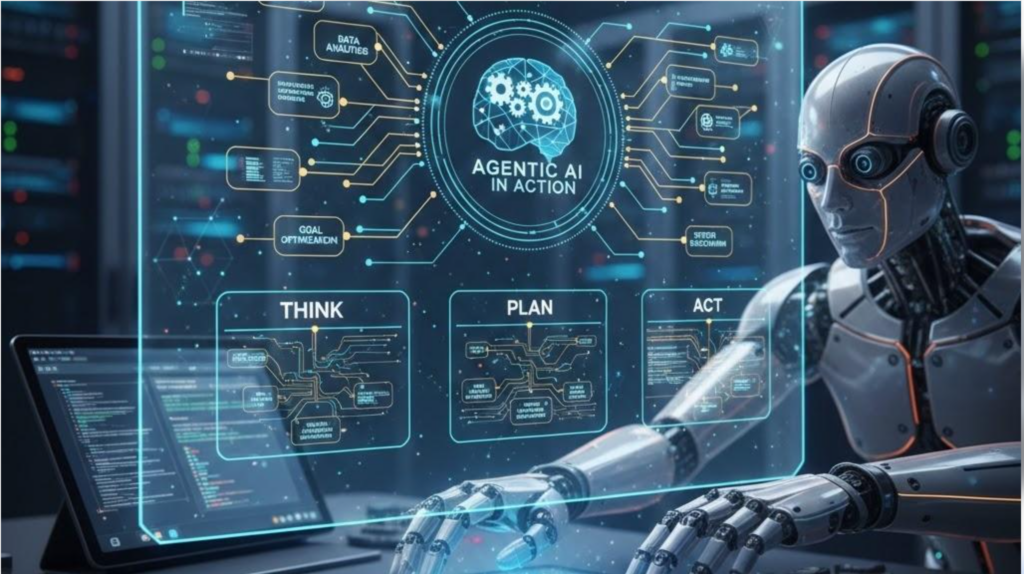
Although different systems use different architectures, an Agentic AI workflow typically follows several stages.
Step 1: Understand the Goal
The agent receives an instruction and identifies the desired result.
For example, a user might ask it to research five project management tools and prepare a comparison.
Step 2: Create a Plan
The agent divides the task into smaller steps, such as identifying relevant tools, gathering information, comparing features, and organizing the results.
Step 3: Use Tools and Gather Information
The agent accesses permitted tools, applications, databases, or search services to collect the information it needs.
The quality of its results depends partly on the reliability and relevance of the available information.
Step 4: Execute the Tasks
The agent performs the required actions, which might include analyzing data, drafting a report, organizing information, or updating an approved record.
Step 5: Review the Results
The system checks whether the task has been completed successfully. If information is missing or an action fails, it may retry, revise its plan, or ask the user for clarification.
Step 6: Request Human Approval When Necessary
For sensitive operations, such as publishing content, making purchases, or modifying important business records, a well-designed workflow can require explicit human confirmation.
This process helps make Agentic AI more useful while keeping important decisions under appropriate control.
Key Benefits of Agentic AI
Agentic AI offers several potential benefits for businesses and individuals.
Higher Productivity
AI agents can handle repetitive activities and multistep digital workflows, allowing people to spend more time on higher-value work.
Improved Efficiency
Agents can coordinate tasks across connected applications, reducing the need to transfer information manually between systems.
Faster Information Processing
Agentic AI can gather and organize information from multiple permitted sources, helping users prepare summaries, reports, and comparisons more efficiently.
Greater Scalability
Organizations can use agent systems to support increasing workloads, provided they have sufficient infrastructure, monitoring, and quality controls.
Personalized Experiences
With appropriate access to relevant context, agents can tailor recommendations, support interactions, and workflows to individual needs.
More Time for Creative Work
By assisting with routine activities, AI agents may give professionals more time for creative problem-solving, relationship building, and strategic planning.
Real-World Applications of Agentic AI
Agentic Artificial Intelligence has potential applications across many industries.
1. Business Operations
Businesses can use AI agents to organize documents, prepare reports, coordinate workflows, and assist with routine administrative activities.
For example, an operations agent could collect weekly performance data, identify missing information, and prepare a draft report for management review.
2. Customer Service
Agentic AI can help customer support teams retrieve relevant information, troubleshoot common problems, classify tickets, and recommend solutions.
More complicated or sensitive cases can be escalated to human representatives.
3. Software Development
Software development agents can help write code, generate tests, investigate bugs, explain unfamiliar code, and suggest improvements.
Developers should still review generated code, test changes, and check for security vulnerabilities before deploying software.
4. Marketing and Content Creation
Marketing teams can use AI agents to research topics, organize campaign ideas, analyze performance data, and prepare content drafts.
For technology websites such as TechGrav, agentic workflows could assist with keyword research, article outlines, content briefs, and editorial planning. Human review remains important for accuracy, originality, and search quality.
5. Finance and Banking
Financial institutions can explore agent-based systems for document processing, transaction monitoring, fraud investigation, and reporting.
Because financial decisions can have significant consequences, these applications require strong security, audit trails, compliance controls, and human oversight.
6. Healthcare
Healthcare organizations can explore AI agents for appointment coordination, administrative documentation, and organizing relevant information.
Clinical applications require careful validation, privacy safeguards, and qualified professional oversight.
7. Education
AI agents can help learners create study plans, practice difficult concepts, organize learning resources, and receive personalized explanations.
Teachers may also use them to develop lesson materials and practice questions, with appropriate checks for accuracy and suitability.
Agentic AI vs. Generative AI: What Is the Difference?
Generative AI and Agentic AI are related, but they emphasize different capabilities.
| Feature | Generative AI | Agentic AI |
|---|---|---|
| Main purpose | Generate content and responses | Work toward defined goals |
| Typical tasks | Writing, images, summaries, code | Multistep workflows and task execution |
| Planning | May support planning | Often uses planning as part of its workflow |
| Tool usage | May use connected tools | Uses tools to help complete objectives |
| Autonomy | Depends on the application | Designed for varying levels of autonomy |
| Example | Drafting a blog article | Researching a topic and preparing a draft for review |
Generative AI can be a component of an Agentic AI system. In many implementations, a language model helps the agent interpret instructions and decide which actions to take.
The two concepts are not mutually exclusive: a single system can combine content generation with goal-directed action.
What Are the Challenges of Agentic AI?
Despite its potential, Agentic AI introduces important challenges that businesses must address.
Accuracy and Reliability
Agents can misunderstand instructions, use incorrect information, or make mistakes while executing a task. Testing and verification are necessary, especially for high-impact applications.
Data Privacy and Security
Agents may access sensitive business information or personal data. Organizations need appropriate permissions, secure integrations, and clear data-handling policies.
Unintended Actions
An agent may interpret a request incorrectly or take an action that the user did not intend. Restricting permissions and requiring approval for consequential actions can reduce this risk.
Cost and Complexity
Running multistep workflows may require several model calls, external tools, and additional monitoring. Organizations should evaluate costs and performance before expanding deployments.
Accountability
When an AI agent makes a mistake, businesses need clear processes for identifying the cause, correcting the outcome, and determining who is responsible.
Human Oversight
Agentic Artificial Intelligence should not automatically receive unlimited authority. Human review is especially important for financial transactions, confidential information, public communications, and irreversible actions.
Is Agentic AI the Future of Artificial Intelligence?
Agentic AI is an important direction in AI development because it connects intelligence with action.
As models, tools, and integrations improve, agents may become increasingly capable of coordinating complex digital workflows. Businesses could use specialized agents for research, operations, customer service, software development, and other activities.
Multi-agent systems may also enable different agents to collaborate on larger projects, with each handling a specific responsibility. Their success will depend on reliable coordination, clear boundaries, and effective evaluation.
At the same time, adoption will not be automatic. Organizations must determine where autonomous workflows provide genuine value and where traditional automation or human expertise is more appropriate.
The future of Agentic AI will depend on both technical progress and responsible implementation.
How Can Beginners Start Using Agentic AI?
You do not need to be a programmer to begin exploring agentic workflows.
- Choose a simple task: Start with research, document organization, or report preparation.
- Define a clear goal: Specify what a successful result should look like.
- Choose an appropriate AI tool: Look for the integrations and capabilities required for your workflow.
- Set permissions: Give the agent only the access it needs.
- Test the results: Check accuracy, consistency, cost, and completion time.
- Keep human review: Approve sensitive or important actions before execution.
- Improve gradually: Expand the workflow only after the initial version performs reliably.
For beginners, research assistance, document summarization, and draft content preparation are useful starting points.
Conclusion: Why Agentic AI Matters in 2026
Agentic Artificial Intelligence is attracting attention in 2026 because it represents a shift from AI that primarily generates responses toward AI systems that can plan and execute multistep tasks.
Its potential applications span business operations, customer service, software development, marketing, finance, education, and healthcare administration. When implemented carefully, these systems can improve productivity and reduce repetitive work.
However, Agentic AI is not a perfect or fully independent digital worker. It can make errors, encounter unexpected situations, and require human supervision. Security, accuracy, accountability, and clear permissions remain essential.
For businesses and individuals, the best approach is to begin with practical use cases, measure the results, and expand gradually as reliability improves.
Agentic Artificial Intelligence is more than a technology trend. It is an emerging approach to making artificial intelligence more action-oriented, useful, and integrated into everyday work.
Follow TechGrav for more insights into artificial intelligence, AI agents, emerging technologies, and the future of digital innovation.

The marketing campaign example captures the real shift well: a chatbot explains how to organize it, while an agent researches the audience, drafts an outline, and prepares content for review. What that comparison glosses over is the review step itself becoming the bottleneck, since a human still has to verify every artifact before anything ships. Your point about restricting permissions for consequential actions feels like the part most teams will underinvest in until an agent takes an unintended action they cannot easily reverse.