
Introduction to Fintech Companies
The way people discover financial products and services is changing rapidly. Instead of relying exclusively on traditional search engines, consumers increasingly use AI-powered assistants and conversational search tools to research digital banking apps, payment gateways, lending platforms, investment services, insurance products, and other financial solutions.
For fintech companies, this shift creates a new marketing challenge: How can your brand appear when potential customers ask AI tools for financial recommendations?
This is where AI visibility tools become valuable. These platforms help businesses understand when and how their brands appear in AI-generated answers, which competitors receive recommendations, what sources influence AI responses, and where content improvements may increase visibility.
Whether you operate a digital bank, payment processing company, lending platform, wealth management startup, or financial technology SaaS business, the right AI visibility tool can help you develop a more effective organic marketing strategy.
In this guide, we explore the best AI visibility tools for fintech companies, their key features, potential use cases, and how to choose the right solution for your business.
Table of Contents
What Are AI Visibility Tools?
AI visibility tools help businesses monitor and improve how their brands appear in responses generated by AI-powered search engines and assistants.
Traditional SEO tools primarily focus on keyword rankings, backlinks, website traffic, and search engine performance. AI visibility platforms add another layer by analyzing brand mentions, citations, recommendations, and competitive presence in AI-generated responses.
For example, a potential customer might ask an AI assistant:
- What are the best payment gateways for small businesses?
- Which digital banking platforms offer international transfers?
- What are the best business lending platforms for startups?
- Which fintech APIs support automated payments?
- What should businesses look for when choosing a fraud prevention platform?
AI visibility tools help fintech marketers investigate whether their company appears in relevant answers and how its presence compares with competing brands.
These platforms can support Generative Engine Optimization (GEO), also known as AI search optimization, and Answer Engine Optimization (AEO). The objective is to make a brand’s information more discoverable, credible, and useful across multiple search experiences.
Why Do Fintech Companies Need AI Visibility Tools?
Fintech is a competitive industry where customers often research pricing, security, reliability, regulatory requirements, and product features before making decisions.
AI search visibility can support several important marketing goals.
1. Monitor Brand Mentions in AI Search
Fintech companies need to understand whether AI assistants mention their products when users research relevant financial services. Visibility monitoring helps identify brand mentions, missing recommendations, and opportunities to improve online information.
2. Understand Competitor Visibility
AI-generated answers may recommend competing payment providers, lending platforms, accounting solutions, or digital banks. Monitoring competitors helps marketing teams identify which brands appear most frequently for important customer questions.
3. Improve Trust and Credibility
Trust is essential in financial services. Clear product documentation, transparent pricing, reliable educational resources, and accurate company information can help users evaluate a fintech brand.
AI visibility tools can help marketers identify content gaps and inconsistencies that deserve attention. However, no tool can guarantee that an AI platform will recommend a particular financial product.
4. Discover New Content Opportunities
AI visibility research can reveal questions that customers ask about financial products, including transaction fees, payment integrations, fraud protection, international transfers, and compliance capabilities.
These questions can inform useful landing pages, comparison articles, FAQs, educational guides, and product documentation.
5. Measure AI Search Performance
Traditional website analytics may not explain how often a brand appears in AI-generated answers. AI visibility platforms provide additional monitoring capabilities that can help teams evaluate their presence across supported AI search experiences.
The available metrics vary by provider, so companies should verify which AI platforms, prompts, countries, and reporting features each tool supports.
10 Best AI Visibility Tools for Fintech Companies
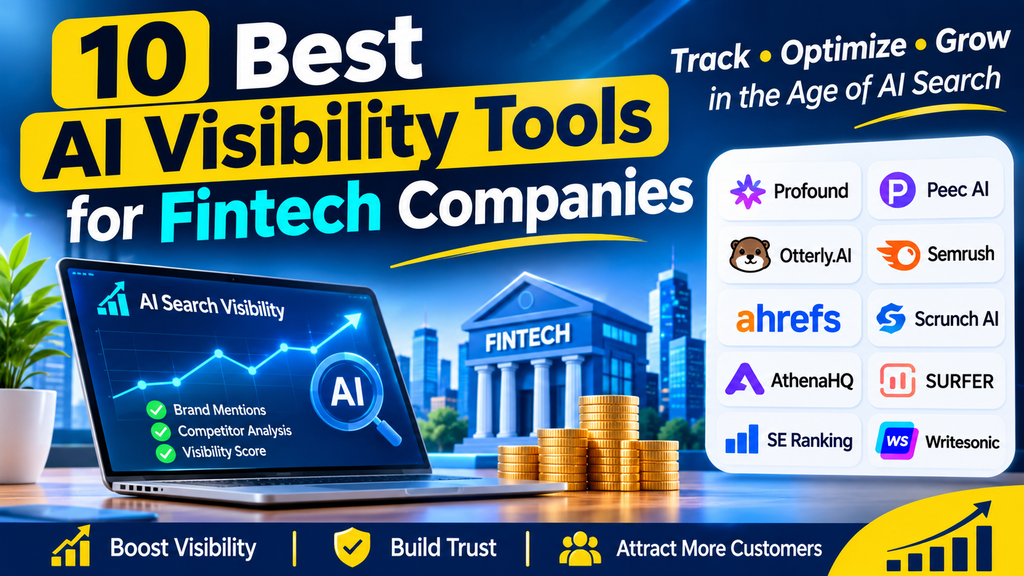
The following tools represent different approaches to AI visibility monitoring, generative search optimization, and brand discovery. Not every platform offers the same coverage, and features may change over time. Fintech companies should confirm current capabilities, data coverage, and pricing before purchasing a subscription.
1. Profound — Best for Enterprise Fintech Companies
Best for: Large fintech companies, digital banks, payment networks, and financial services enterprises.
Profound is an AI visibility and answer engine optimization platform designed to help businesses understand how their brands appear across AI-powered search experiences.
For fintech companies operating in competitive markets, monitoring AI-generated recommendations can help identify gaps in brand awareness and content coverage.
Key Features
- AI search visibility tracking.
- Brand mention and citation analysis.
- Competitor visibility monitoring.
- Insights into the sources referenced by AI assistants.
- Reporting capabilities for enterprise marketing teams.
How Fintech Companies Can Use It
A digital banking company could monitor questions such as “best digital banking platforms for small businesses” or “best business banking software for startups.”
The marketing team could then analyze which competitors appear in AI answers and identify relevant content opportunities.
Verdict: Consider Profound if your fintech company needs advanced AI visibility monitoring and enterprise-oriented reporting.
2. Peec AI — Best for AI Search Analytics
Best for: Fintech marketing teams, SEO specialists, and growing financial technology companies.
Peec AI focuses on monitoring brand visibility across supported AI search platforms and analyzing how brands appear in AI-generated responses.
Its analytics approach can help marketing teams understand their visibility trends, compare competitors, and identify sources that influence AI answers.
Key Features
- AI brand visibility tracking.
- Competitor comparisons.
- Citation and source analysis.
- Prompt-level performance monitoring.
- Reporting for marketing teams.
How Fintech Companies Can Use It
A payment gateway provider could track prompts related to online payment processing, international transactions, subscription billing, and payment API integrations.
These insights can help the company understand whether its brand appears in relevant recommendations and which topics deserve additional content.
Verdict: Peec AI is worth evaluating if you want a dedicated AI visibility analytics platform rather than relying exclusively on traditional SEO tools.
3. Otterly.AI — Best for Small Fintech Startups
Best for: Early-stage fintech startups, small marketing teams, and businesses beginning their AI search optimization journey.
Otterly.AI helps companies monitor brand mentions and citations across supported AI search platforms.
For smaller fintech businesses, a dedicated monitoring tool can provide a starting point for understanding how AI-generated answers represent their products.
Key Features
- AI search monitoring.
- Brand mention tracking.
- Citation monitoring.
- Competitor visibility analysis.
- GEO auditing capabilities.
How Fintech Companies Can Use It
A startup offering invoicing software or automated payment solutions could track industry-specific prompts to understand whether its brand appears alongside established competitors.
The company could use these insights to improve product pages, publish educational content, and strengthen its online presence.
Verdict: Consider Otterly.AI if you need straightforward AI visibility monitoring without investing immediately in an enterprise platform.
4. Semrush AI Visibility Toolkit — Best for SEO and AI Visibility Together
Best for: Fintech companies already investing in search engine optimization.
Semrush combines traditional SEO capabilities with tools for understanding brand visibility in AI-generated search results.
This can be useful for fintech marketing teams that want to analyze website performance, research competitors, discover keywords, and monitor AI search visibility within a connected workflow.
Key Features
- AI visibility tracking.
- Traditional keyword research.
- Competitor analysis.
- Website auditing.
- Content optimization capabilities.
How Fintech Companies Can Use It
A financial SaaS company could investigate which educational articles attract organic search traffic and compare those topics with questions where its brand is missing from AI-generated responses.
This can help prioritize content improvements across both traditional search and AI discovery channels.
Verdict: Semrush is a strong candidate for fintech companies that want AI visibility insights alongside established SEO workflows.
5. Ahrefs Brand Radar — Best for Brand and Competitor Research
Best for: Fintech businesses with established SEO programs and competitive research requirements.
Ahrefs Brand Radar helps businesses research brand presence across supported AI search experiences.
Its brand research capabilities can help fintech marketers investigate how their company compares with competitors and explore the online sources associated with brand visibility.
Key Features
- AI brand visibility research.
- Competitor monitoring.
- Brand mention analysis.
- Search demand and content research capabilities.
- Integration with broader SEO research workflows.
How Fintech Companies Can Use It
A wealth management technology company could investigate which brands appear in AI answers about investment platforms, portfolio management software, and financial planning applications.
The results can help inform competitor research and content planning.
Verdict: Ahrefs Brand Radar is worth considering if your marketing team already uses Ahrefs or needs AI brand research alongside conventional SEO analysis.
6. Scrunch AI — Best for AI Discovery and Website Optimization
Best for: Fintech companies seeking to understand how AI systems discover and represent their websites.
Scrunch AI focuses on AI search visibility and helping companies understand how their brands and website content appear in AI-powered discovery experiences.
Depending on the plan, its capabilities may also support website optimization for AI-driven experiences.
Key Features
- AI search visibility monitoring.
- Brand and competitor analysis.
- Insights into AI-generated responses.
- Website optimization capabilities.
- Tools for understanding AI-driven discovery.
How Fintech Companies Can Use It
A fintech SaaS provider could investigate whether AI assistants correctly understand its product features, supported integrations, target customers, and pricing information.
This is particularly important when inaccurate or incomplete descriptions could confuse potential customers.
Verdict: Scrunch AI is worth evaluating if your company wants to explore both AI visibility monitoring and website readiness for AI-driven discovery.
7. AthenaHQ — Best for Advanced AI Search Monitoring
Best for: Growing fintech brands and marketing teams with broader AI visibility requirements.
AthenaHQ is an AI search optimization platform focused on monitoring brand presence and helping businesses improve how they appear across supported AI search engines.
Its broader monitoring approach may be useful for companies that want to compare performance across multiple AI discovery channels.
Key Features
- AI search visibility tracking.
- Competitor monitoring.
- Brand mention analysis.
- Source and citation insights.
- AI search optimization recommendations.
How Fintech Companies Can Use It
A business lending platform could monitor AI-generated answers about working capital loans, small business financing, and lending software.
The team could use the findings to identify gaps in its educational resources and improve pages explaining eligibility, fees, repayment terms, and product features.
Verdict: Consider AthenaHQ if your fintech company needs broader AI visibility monitoring and actionable optimization insights.
8. Surfer — Best for Content Optimization
Best for: Fintech content marketing teams and companies publishing educational financial content.
Surfer is primarily a content optimization platform that helps businesses improve their content using SEO-related analysis. Its evolving AI search capabilities can also support content teams working to improve visibility in AI-powered discovery.
Key Features
- Content optimization.
- Search intent analysis.
- Content structure recommendations.
- SEO content research.
- AI visibility-related capabilities, depending on the current offering.
How Fintech Companies Can Use It
A fintech company could use content optimization workflows to improve guides about payment processing, digital wallets, financial automation, and accounting integrations.
Content should answer specific customer questions clearly, use accurate terminology, and explain product features without exaggerated claims.
Verdict: Surfer is a useful option for fintech businesses that need stronger content workflows to support their organic search strategy.
9. SE Ranking — Best for Combining SEO and AI Search Insights
Best for: Small and medium-sized fintech companies managing SEO in-house.
SE Ranking provides SEO research and website monitoring tools, with AI visibility capabilities available through its evolving product offerings.
It can help teams connect conventional search performance with emerging AI search monitoring.
Key Features
- Keyword tracking and research.
- Competitor analysis.
- Website audits.
- SEO reporting.
- AI search visibility features, depending on the plan.
How Fintech Companies Can Use It
A financial technology company could track the performance of landing pages targeting searches related to payment automation, expense management, or digital lending.
The team could use these findings alongside AI visibility reports to develop a more complete organic marketing strategy.
Verdict: SE Ranking is worth comparing if you want an SEO platform with AI visibility capabilities rather than a standalone AI monitoring product.
10. Writesonic — Best for AI Content and Search Optimization Workflows
Best for: Fintech startups that need support with content production and organic growth.
Writesonic offers AI-powered content creation and marketing capabilities, with features for AI search visibility and optimization depending on the current plan.
For fintech companies with limited marketing resources, combining content workflows with search visibility insights may help streamline campaign planning.
Key Features
- AI-assisted content creation.
- SEO content workflows.
- Content optimization.
- AI search visibility capabilities, depending on the offering.
- Marketing productivity features.
How Fintech Companies Can Use It
A fintech startup could plan educational articles about payment integrations, financial automation, business banking, or fraud prevention.
Subject-matter experts should review financial claims, security statements, and regulatory information before publication.
Verdict: Writesonic is worth evaluating if your team wants content production and AI search optimization capabilities within a connected workflow.
AI Visibility Tools Comparison Table
The following table summarizes the primary use cases of these platforms. It is a qualitative guide, not an independently tested ranking. Features and availability can vary by subscription.
| Tool | Best For | Main Focus |
|---|---|---|
| Profound | Enterprise fintech companies | AI visibility analytics |
| Peec AI | Marketing and SEO teams | AI search monitoring |
| Otterly.AI | Small fintech startups | Brand mention tracking |
| Semrush | Established marketing teams | SEO and AI visibility |
| Ahrefs Brand Radar | Competitive research | Brand visibility research |
| Scrunch AI | AI discovery optimization | AI visibility and website readiness |
| AthenaHQ | Growing fintech companies | AI search monitoring |
| Surfer | Content marketing teams | Content optimization |
| SE Ranking | Small and medium-sized businesses | SEO and AI search insights |
| Writesonic | Content-focused startups | AI content and search workflows |
How to Choose the Right AI Visibility Tool for Your Fintech Company
The best tool depends on your marketing objectives, company size, budget, and the AI search platforms your customers use.
1. Define Your AI Visibility Goals
Before buying a subscription, determine what you need to measure.
For example:
- Are you trying to increase brand mentions in AI-generated answers?
- Do you want to know which competitors are recommended most frequently?
- Do you need to identify the websites and sources cited by AI assistants?
- Are you trying to improve your fintech website’s content?
- Do you need executive reporting for marketing performance?
Choose a platform based on your most important business requirements rather than the number of features advertised.
2. Check Which AI Platforms Are Supported
Different tools monitor different combinations of AI search experiences.
Check whether the platform supports the services most relevant to your customers, such as ChatGPT, Google AI Overviews, Google AI Mode, Gemini, Perplexity, Claude, or Microsoft Copilot.
Also verify whether your selected subscription includes these platforms. Some providers offer broader coverage only on higher-tier plans.
3. Prioritize Competitor and Citation Analysis
For fintech companies, knowing that a brand appears in an AI response is only the beginning.
You should also investigate:
- Which competitors appear in the same answer.
- Which sources the AI response references.
- Whether your website is cited.
- Whether the response accurately describes your product.
- Which customer questions produce the strongest or weakest visibility.
These insights can help your team decide where to improve content and online brand information.
4. Evaluate Reporting and Integration Options
If your fintech company has an established marketing department, look for reporting, exports, integrations, and API access where needed.
Consider whether the tool fits your existing analytics and SEO workflows.
For larger organizations, review user permissions, data handling, security documentation, contractual terms, and enterprise support before onboarding the platform.
5. Compare Pricing With Practical Value
Do not choose a tool simply because it has the lowest subscription price.
Compare the number of prompts you can track, the AI platforms included, monitoring frequency, reporting options, number of projects, and available competitor analysis.
A smaller fintech startup may need only a focused set of prompts, while an international fintech company may require multiple markets, languages, products, and business units.
How Fintech Companies Can Improve Their AI Search Visibility
An AI visibility platform helps you measure your presence, but purchasing a tool alone will not guarantee better recommendations.
To improve visibility, fintech companies need to strengthen their content, website structure, and online credibility.
1. Publish Helpful Financial Education Content
Create content that answers real customer questions.
Examples include:
- How does payment processing work?
- What is the difference between a payment gateway and a payment processor?
- How can small businesses automate invoice payments?
- What should companies consider when choosing a digital banking platform?
- How can businesses evaluate fraud prevention software?
Use clear language and practical examples. Explain technical concepts without unnecessary jargon.
2. Create Detailed Product Pages
Your product pages should clearly explain what your platform does and who it serves.
Include relevant information about:
- Product features.
- Pricing and fees.
- Supported integrations.
- Eligibility requirements.
- Geographic availability.
- Security capabilities.
- Customer support.
- Limitations and exclusions.
Keep this information accurate and consistent across your website and other official company profiles.
3. Strengthen Trust and Financial Accuracy
Financial services require particular care because misleading information can affect important decisions.
Make your content transparent about fees, risks, limitations, and eligibility.
Where appropriate, include qualified authors, expert reviewers, publication dates, references to authoritative sources, and clear explanations of your company’s regulatory status.
Never imply that a company is licensed, regulated, insured, or guaranteed to produce a particular financial outcome unless the statement is accurate and properly supported.
4. Build a Strong Online Reputation
AI-generated answers may draw on information from multiple websites and other sources.
Fintech companies should maintain accurate business listings, develop useful industry resources, encourage genuine customer reviews, and pursue relevant editorial coverage.
Avoid buying fake reviews, creating misleading claims, or publishing large quantities of low-quality content solely to influence AI recommendations.
5. Measure Results Consistently
Develop a repeatable set of prompts based on your customers’ questions.
For example, a payment technology company might monitor:
- Best payment gateways for e-commerce businesses.
- Payment processors with recurring billing features.
- Alternatives to a particular payment platform.
- Payment APIs for SaaS businesses.
- International payment solutions for online merchants.
Track brand mentions, citations, competitor appearances, and response accuracy over time.
Because AI answers can change between runs, markets, and user contexts, interpret the results as indicators rather than guaranteed rankings or fixed positions.
Common Challenges With AI Visibility in Fintech
Regulatory and Compliance Requirements
Financial content must meet applicable legal, regulatory, and advertising requirements. Before publishing new pages, review statements about investment performance, lending terms, financial risks, fees, and regulatory approvals.
Highly Competitive Search Results
Established banks, financial publishers, and major fintech brands may have stronger online recognition and broader content coverage.
Smaller companies can respond by developing useful, specific resources that address underserved customer questions.
Inaccurate AI-Generated Information
AI systems can misunderstand product features, use outdated information, or make incorrect statements.
Monitor important prompts and correct inaccuracies through reliable, up-to-date information on your official website and other appropriate channels. Do not assume that publishing a correction will immediately change every AI response.
Measuring Business Impact
AI mentions do not necessarily translate into website visits, qualified leads, or customers.
Where possible, combine AI visibility reporting with website analytics, referral traffic, conversion tracking, and CRM data to understand whether your efforts are producing meaningful business outcomes.
Frequently Asked Questions
1. What are the best AI visibility tools for fintech companies?
Profound, Peec AI, Otterly.AI, Semrush, Ahrefs Brand Radar, Scrunch AI, and AthenaHQ are among the platforms worth evaluating. The best choice depends on your budget, required AI platform coverage, reporting needs, and existing marketing tools.
2. How do AI visibility tools help fintech companies?
They help fintech marketers monitor brand mentions, analyze AI-generated recommendations, compare competitors, investigate cited sources, and identify content opportunities. These insights can support an AI search optimization strategy.
3. What is Generative Engine Optimization (GEO)?
Generative Engine Optimization is the practice of improving a company’s content and online presence so it can be discovered, understood, referenced, or recommended in AI-generated answers. GEO complements traditional SEO but does not guarantee inclusion in AI responses.
4. Can AI visibility tools improve fintech customer acquisition?
They can help identify opportunities to improve brand discovery, but they do not guarantee customer acquisition. To evaluate business impact, combine visibility data with qualified leads, referral traffic, conversion rates, and customer acquisition costs.
5. Are AI visibility tools suitable for fintech startups?
Yes. Startups can use these tools to understand how their brands compare with established competitors and identify useful content opportunities. A startup should begin with a manageable set of high-intent customer questions and expand its monitoring as needed.
6. Do AI visibility tools replace traditional SEO tools?
No. Traditional SEO remains important for website discoverability, technical health, keyword research, and organic traffic. AI visibility monitoring adds another measurement layer by examining how brands appear in supported AI-generated responses.
7. How often should fintech companies monitor AI visibility?
Weekly or daily monitoring can be useful for important prompts, depending on the tool and subscription. However, trends across repeated observations are generally more informative than a single AI response.
8. What should fintech companies consider before buying an AI visibility platform?
Evaluate AI platform coverage, prompt limits, citation analysis, competitor research, geographic coverage, reporting, integrations, security, data handling, and total subscription cost. Test the platform against real customer questions before committing to a long-term contract.
Conclusion
AI-powered search is creating new opportunities for fintech companies to connect with customers researching banking, payments, lending, financial software, and investment technology.
The best AI visibility tools help marketing teams understand how their brands appear in AI-generated answers, which competitors receive attention, and where content improvements may be needed.
For enterprise monitoring, consider Profound. For dedicated AI search analytics, evaluate Peec AI. For a smaller startup, explore Otterly.AI. If you already have an established SEO workflow, compare Semrush and Ahrefs Brand Radar.
Whichever platform you choose, remember that visibility monitoring is only one part of the strategy. Accurate financial information, transparent product pages, useful educational content, and a trustworthy online presence remain essential.
Start by defining the customer questions that matter most to your business, monitor how AI systems answer them, and use the findings to build a measurable, compliance-conscious AI search optimization strategy.