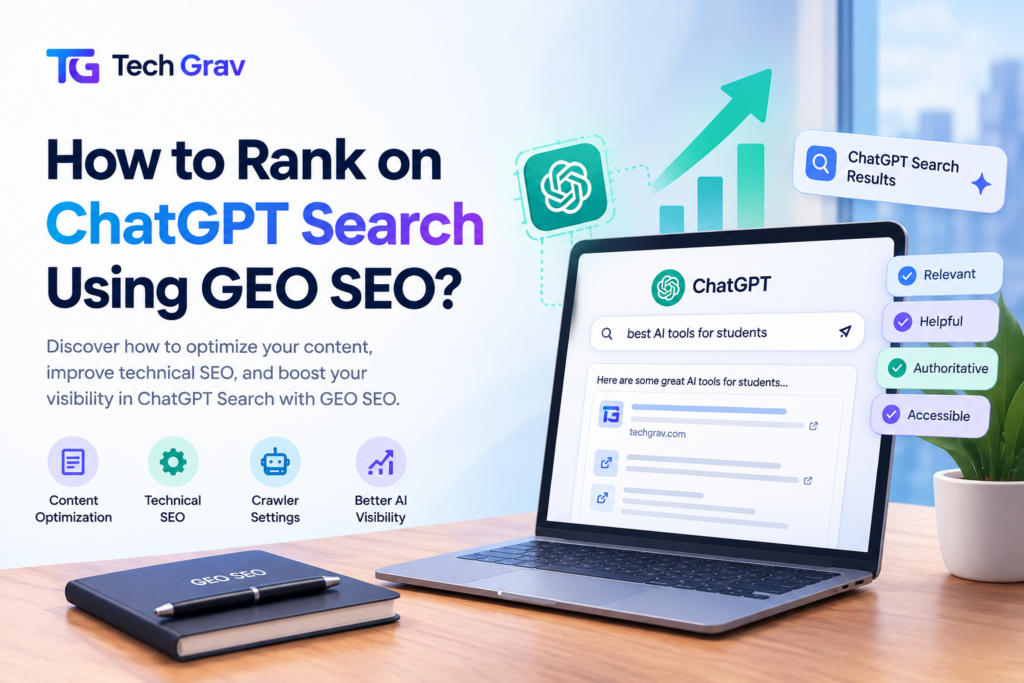
Learn how to rank on ChatGPT Search using GEO SEO in 2026. Discover proven strategies to improve AI visibility, earn citations, and attract more organic traffic.
Artificial intelligence is changing how people discover information online. Instead of relying only on traditional search engines, users are increasingly asking AI platforms questions and exploring the sources behind their answers. This shift creates a new opportunity for website owners, bloggers, and businesses to improve their online visibility.
One strategy gaining attention is Generative Engine Optimization (GEO), commonly called GEO SEO. It focuses on making website content easier for AI-powered search experiences to discover, understand, and potentially reference.
If you run a website like Tech Grav, optimizing for ChatGPT Search can help you reach people looking for AI tools, technology tutorials, software recommendations, and practical digital solutions.
In this guide, you will learn how ChatGPT Search works, how to optimize your website for AI search, and which SEO practices can improve your chances of being discovered and cited.
Table of Contents
What is GEO SEO?
Generative Engine Optimization (GEO) is the practice of improving a website’s content and technical accessibility so that it has a better chance of being discovered, understood, and referenced by generative AI systems.
Traditional SEO focuses on improving visibility in search engine results. GEO SEO extends this goal to AI-powered search experiences, including ChatGPT Search and other tools that generate answers using information from the web.
GEO SEO commonly involves:
- Creating accurate, helpful, and original content.
- Organizing information with clear headings and explanations.
- Making website pages accessible to search crawlers.
- Establishing credibility through relevant references and genuine expertise.
- Keeping important information current.
- Building a recognizable and trustworthy online presence.
Important: GEO SEO does not guarantee that ChatGPT will mention your website. AI-generated responses and their cited sources can vary depending on the question, available information, and relevance of individual pages.
How Does ChatGPT Search Work?
ChatGPT Search can use web search to retrieve relevant information and provide answers with links to supporting sources. This allows users to explore information beyond the AI-generated response.
For a website to have a chance of appearing as a source, its content needs to be accessible and relevant to the user’s query.
For example, someone might ask ChatGPT:
- What are the best free AI tools for students?
- How can small businesses automate repetitive tasks?
- Which AI writing tools offer free plans?
- How do AI agents differ from AI chatbots?
If your website publishes a useful, accurate, and relevant article addressing one of these questions, it may be considered as a potential source.
However, simply publishing an article or adding keywords does not guarantee inclusion. Your website must compete with other relevant sources, and ChatGPT may not cite the same pages for every query.
10 Ways to Improve Your Website’s Visibility in ChatGPT Search
1. Create Helpful, Original, and Reliable Content
Content quality should be the foundation of your GEO SEO strategy.
Avoid publishing articles that merely repeat information already available across dozens of websites. Instead, give readers something useful, such as original research, practical examples, firsthand testing, expert commentary, or clear explanations.
For example, instead of publishing a generic article titled “Best AI Tools in 2026,” create a more useful guide that explains:
- What each tool does.
- Which features are available for free.
- Its main advantages and limitations.
- Who should use it.
- How it performs in a practical test.
Whenever possible, include screenshots, test results, and examples from your own experience. Review factual claims before publishing.
2. Allow OpenAI’s Search Crawler
One of the most important technical checks is ensuring that your website does not unintentionally block OpenAI’s search crawler.
OpenAI uses a crawler called OAI-SearchBot to help surface websites in ChatGPT Search results. If your site blocks this crawler, your content may not be shown in ChatGPT Search answers.
To check your website:
- Open your WordPress website’s
robots.txtfile. - Look for rules that block
OAI-SearchBotor prevent it from accessing relevant pages. - Review any additional restrictions imposed by your CDN, firewall, hosting provider, or security plugin.
- If necessary, update the rules to allow the search crawler.
- Check the official OpenAI crawler documentation for current instructions.
For example, a basic robots.txt rule that allows the search crawler is:
User-agent: OAI-SearchBot
Allow: /
Only add or change rules after checking your existing robots.txt configuration. Do not replace your entire file blindly.
Also, note that OAI-SearchBot and GPTBot serve different purposes. Allowing OAI-SearchBot for search visibility does not require you to allow GPTBot for model training.
Official reference: https://developers.openai.com/api/docs/bots
3. Follow Strong Traditional SEO Practices
GEO SEO does not replace traditional SEO. Search engines and AI-powered search experiences still need accessible, understandable, relevant information.
Make sure your website has:
- A logical website structure.
- Descriptive page titles.
- Useful meta descriptions.
- Clean and readable URLs.
- Relevant internal links.
- Mobile-friendly pages.
- Fast and reliable page loading.
- An XML sitemap.
- Correct canonical tags and indexing settings.
Use Google Search Console to identify indexing problems and understand which queries bring visitors to your website.
For WordPress sites, a free SEO plugin can help manage titles, descriptions, XML sitemaps, and other basic SEO settings.
4. Structure Articles With Clear Headings
A well-organized article is easier for readers to scan and understand.
Use one clear H1 title, followed by descriptive H2 headings and relevant H3 subheadings. Keep each section focused on a specific topic.
For example, an article about AI automation might use this structure:
- H1: How AI Automation Helps Small Businesses
- H2: What Is AI Automation?
- H2: Benefits of AI Automation
- H2: Best AI Automation Tools
- H2: How to Choose an Automation Tool
- H2: Frequently Asked Questions
Answer the main question early in the article. Then provide details, examples, comparisons, and supporting information.
Clear structure is a sound content practice, but there is no guarantee that a particular heading format will make ChatGPT cite your page.
5. Answer Specific Questions Directly
Many people use conversational questions when searching with AI.
Build content around the actual questions your audience asks. Useful formats include:
- What is GEO SEO?
- How does ChatGPT Search work?
- How can I improve my website’s visibility in AI search?
- Which free AI tools are best for students?
- How do you compare AI automation platforms?
Provide a concise, direct answer near the beginning of each relevant section. Follow it with evidence, explanations, examples, and limitations.
Avoid adding unnecessary paragraphs simply to increase word count. Every section should help the reader understand the topic or make a decision.
6. Build Credibility With Reliable Sources
Credibility matters when publishing technical, financial, medical, or other information where accuracy is important.
Support factual statements with trustworthy references. For technology articles, prefer official documentation, product specifications, original research, and reputable industry sources.
For example, when explaining ChatGPT Search, link to official OpenAI documentation. When discussing Google Search optimization, consult Google Search Central.
You can also strengthen your website’s credibility by:
- Publishing accurate author biographies.
- Maintaining an About page.
- Providing clear contact information.
- Disclosing affiliate relationships when applicable.
- Correcting outdated or inaccurate content.
- Distinguishing tested facts from opinions.
These practices help readers evaluate your content and understand where the information comes from.
7. Earn Relevant Mentions and Backlinks
Relevant backlinks and brand mentions can help people discover your website and can contribute to your broader SEO strategy.
Focus on earning links from websites that genuinely cover technology, artificial intelligence, software, education, or related subjects.
Some useful approaches include:
- Writing legitimate guest posts.
- Publishing original surveys or research.
- Creating useful technology resources.
- Contributing expert commentary.
- Collaborating with relevant publishers.
- Sharing original tutorials that solve real problems.
Do not buy spammy links or create artificial brand mentions simply to influence AI responses. There is no verified formula showing that a specific number of mentions will make ChatGPT recommend a website.
8. Use Structured Data Correctly
Structured data helps search engines interpret information about a page and the entities it describes.
Depending on your content, relevant schema types may include:
- Article
- Organization
- Person
- BreadcrumbList
- Product, where appropriate and accurate
For WordPress, an SEO plugin can help generate some of these structured data types.
Make sure the markup accurately reflects the content visible on your page. Do not add false ratings, invented reviews, or unsupported claims.
Structured data is not a guaranteed shortcut to ChatGPT Search visibility. Focus on using it correctly for its intended purpose rather than adding unnecessary markup.
9. Keep Important Articles Updated
AI and technology change quickly. A tool that offered a free plan last year may now have different pricing, features, or limitations.
Review important articles regularly and update information when meaningful changes occur.
For software comparisons, verify:
- Current pricing.
- Free-plan limitations.
- Available features.
- Supported platforms.
- Product availability.
- Official documentation links.
Display publication and update dates accurately. Do not change dates merely to make an article appear fresh.
For Tech Grav, regularly updating AI tool guides, automation tutorials, and technology explainers can help keep the website useful and relevant.
10. Monitor AI Search Visibility
GEO SEO should be measured rather than treated as a collection of unverified tricks.
Start by tracking traditional SEO performance in Google Search Console. Review impressions, clicks, average positions, and the queries that lead visitors to your website.
You can also conduct repeatable ChatGPT Search checks using relevant questions.
For example:
- “What are useful websites for learning about AI tools?”
- “Which websites explain AI agents for beginners?”
- “Where can I find practical WordPress and technology tutorials?”
Record whether your website appears, which page is cited, and which competing sources are mentioned.
Repeat the checks periodically using similar prompts. AI answers can change, so one successful result does not establish consistent visibility.
Where available, use referral analytics and server logs to investigate traffic from AI platforms and crawler activity. Remember that crawler visits do not necessarily mean a page has been cited or that a human visitor has arrived.
GEO SEO Checklist for WordPress Websites
Before publishing an article on Tech Grav, use this checklist:
- Write an accurate, useful, original article.
- Select a clear primary keyword and relevant supporting topics.
- Create an SEO-friendly title, meta description, and URL slug.
- Organize the content with descriptive headings.
- Answer the main question early.
- Add relevant internal links.
- Cite trustworthy external sources where needed.
- Add suitable images with descriptive alt text.
- Verify that the page is accessible to search crawlers.
- Check that important pages are indexable.
- Validate relevant structured data.
- Review the article for factual accuracy and outdated information.
- Monitor performance after publication.
For ChatGPT Search specifically, pay particular attention to whether OAI-SearchBot can access the relevant content.
Common GEO SEO Mistakes to Avoid
Publishing Large Amounts of Generic AI Content
Using AI tools to assist with research and drafting can be useful. However, publishing large numbers of similar articles without adding meaningful value can create a poor experience for readers.
Edit and fact-check AI-assisted drafts. Add original insights, practical examples, and clear explanations.
Blocking Search Crawlers Accidentally
A restrictive robots.txt file, firewall rule, or security setting may prevent crawlers from accessing important pages. Check the relevant rules before making technical changes.
Stuffing Keywords Into Every Paragraph
Repeatedly inserting phrases such as “rank on ChatGPT Search” does not make an article more useful. Use the primary keyword naturally and cover related questions where relevant.
Buying Guaranteed AI Rankings
Be cautious of services that promise guaranteed ChatGPT citations, instant AI rankings, or secret ranking factors. No legitimate provider can guarantee that ChatGPT will cite a specific page for every relevant question.
Ignoring Traditional Search Performance
A website still needs useful content, discoverable pages, a clear structure, and sound technical SEO. Do not neglect these foundations in pursuit of speculative GEO tactics.
Frequently Asked Questions About GEO SEO
What is GEO SEO?
GEO SEO stands for Generative Engine Optimization. It describes efforts to improve a website’s discoverability and potential visibility in AI-powered search and answer experiences.
How can I rank on ChatGPT Search?
Publish useful and accurate content, allow OAI-SearchBot to access relevant pages, maintain sound technical SEO, build genuine credibility, and monitor whether your pages are cited. There is no guaranteed method to secure a citation.
Is GEO SEO different from traditional SEO?
GEO emphasizes visibility in generative AI experiences, while traditional SEO focuses on search engine discovery and rankings. The two overlap significantly in areas such as content quality, crawlability, relevance, and website structure.
Do I need a special plugin to rank on ChatGPT Search?
No special WordPress plugin guarantees ChatGPT Search visibility. An SEO plugin can help with standard SEO tasks, but you should separately check crawler access and your website’s technical configuration.
Does ChatGPT use OAI-SearchBot?
Yes. OpenAI documents OAI-SearchBot as a crawler used to surface websites in ChatGPT Search results. Allowing it can help make your website eligible for inclusion, but it does not guarantee that your pages will be cited.
Does adding an llms.txt file improve ChatGPT rankings?
There is no established guarantee that adding an llms.txt file will improve ChatGPT Search visibility. Prioritize documented crawler access, useful content, and established SEO practices before experimenting with optional files.
How long does GEO SEO take to work?
There is no fixed timeline. Discoverability and citations depend on factors such as crawl access, content relevance, competition, and changes in AI search systems. Monitor your website over time instead of expecting immediate results.
Conclusion
Generative Engine Optimization offers website owners another way to think about online visibility as AI-powered search becomes more common. However, the strongest approach is not to chase secret ranking tricks. It is to make your website useful, accessible, accurate, and easy to understand.
For Tech Grav, start with original AI and technology guides, improve technical SEO, verify OAI-SearchBot access, maintain trustworthy sources, and regularly review how your content performs.
The goal is simple: create content that genuinely helps people, and make it easy for search systems to discover and evaluate it.