
AI Agents: The Next Generation of Artificial Intelligence
Artificial intelligence is evolving rapidly, moving beyond chatbots and simple automation toward systems that can plan, make decisions, and perform tasks with greater independence. One of the most exciting developments in this evolution is AI agents.
From automating business workflows to assisting with research, customer service, software development, and data analysis, AI agents are changing how people interact with technology. They can understand goals, break complex tasks into smaller steps, use digital tools, and adapt their actions based on results.
But what exactly are AI agents? How do they work, and why are they considered the next generation of artificial intelligence?
In this guide, we will explore everything you need to know about AI agents, their benefits, practical applications, challenges, and future potential.
Table of Contents
What Are AI Agents?
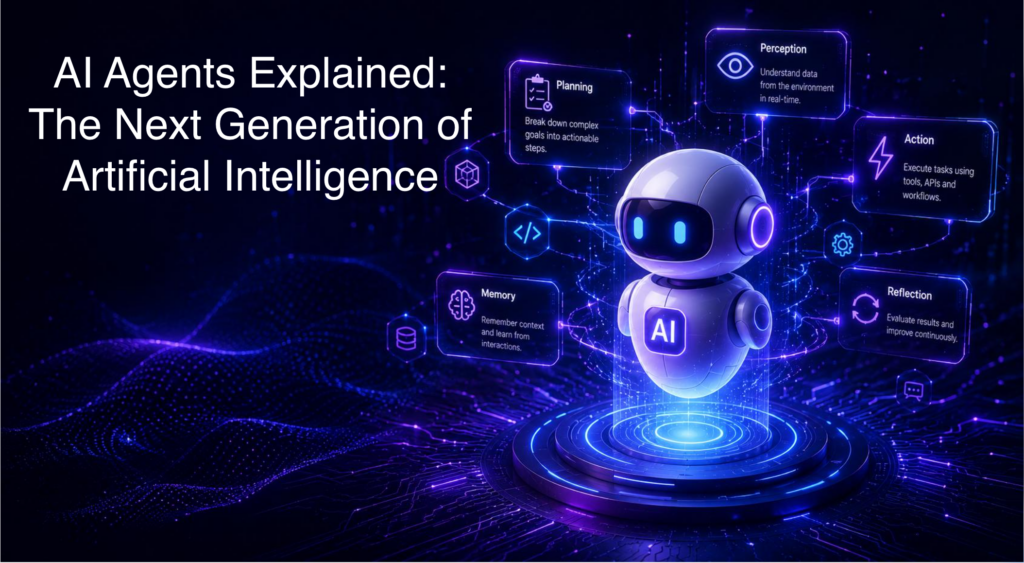
AI agents are software systems designed to perceive information, reason about a goal, and take actions to achieve specific objectives. Depending on their design, they can operate with varying levels of autonomy, from recommending the next step to completing multistep tasks with limited human intervention.
Traditional AI tools often respond to individual instructions. For example, a basic chatbot might answer a question, while an AI agent could research a topic, organize the findings, prepare a report, and present the results.
AI agents may use large language models (LLMs), memory, external tools, APIs, and planning mechanisms to complete these tasks.
The main difference is that an AI agent can move beyond generating a response and work toward achieving a defined goal.
How Do AI Agents Work?
AI agents combine several technologies to understand instructions, make decisions, and perform actions. Although their architecture varies, most follow a general process.
1. Understanding the Goal
First, the agent receives an objective from a user or another system. It interprets the instruction, identifies the expected outcome, and determines what information or resources it needs.
For example, a research agent might receive the task of comparing several project management tools based on features, pricing, and suitability for small businesses.
2. Planning and Reasoning
The agent breaks the objective into smaller tasks and determines a possible sequence of actions. More advanced systems can revise their plans when they encounter new information or unexpected results.
A research agent might decide to identify suitable products, gather information from reliable sources, compare their features, and organize the findings into a report.
3. Using Tools and Gathering Information
AI agents can connect to external tools, databases, web services, and business applications when they have the necessary permissions.
Depending on their configuration, they may search documents, retrieve data, run calculations, update records, or interact with software through APIs.
Tool access expands what an agent can accomplish beyond the information contained in its underlying AI model.
4. Taking Action
After planning, the agent executes the steps needed to achieve its goal. These actions may include drafting emails, preparing reports, organizing files, or updating approved business records.
Sensitive actions, such as making payments, deleting important data, or sending confidential information, should require appropriate authorization and safeguards.
5. Evaluating Results and Improving the Process
The agent checks whether its actions achieved the intended result. If something is missing or an operation fails, it may try another approach or ask the user for clarification.
Some systems also use stored feedback or evaluation mechanisms to improve future performance. However, not every AI agent learns automatically from each interaction.
Key Components of an AI Agent
Several components work together to make an AI agent useful.
Large Language Models (LLMs)
LLMs help agents understand natural language, interpret instructions, summarize information, and generate plans or responses.
Memory and Context
Memory mechanisms allow an agent to retain relevant information across steps or interactions, depending on the system’s design and privacy settings.
Planning and Reasoning
Planning helps an agent divide a large objective into manageable tasks and decide which steps to perform first.
Tools and Integrations
Tools enable agents to interact with external applications, databases, search systems, and APIs.
Feedback and Evaluation
Evaluation mechanisms help determine whether an action succeeded and whether additional work is required.
Together, these components enable AI agents to handle tasks that involve multiple steps, decisions, and interactions with digital systems.
AI Agents vs. Traditional AI vs. AI Chatbots
Although these technologies overlap, they serve different purposes.
| Feature | Traditional AI | AI Chatbot | AI Agent |
|---|---|---|---|
| Primary purpose | Make predictions or classifications | Answer questions and generate responses | Work toward defined goals |
| Task execution | Usually predefined | Primarily conversational | Can execute multistep workflows |
| Tool usage | Depends on implementation | May have integrations | Often uses tools as part of a plan |
| Autonomy | Varies by system | Usually limited | Can be configured for greater autonomy |
| Human supervision | Depends on the application | Often required for follow-up tasks | Depends on risk and permissions |
For example, a traditional AI model might classify customer feedback, a chatbot might explain a product’s features, and an AI agent might analyze customer feedback, categorize complaints, draft responses, and create a summary for a support team.
These are general distinctions rather than strict boundaries. Modern chatbots can also have agent-like capabilities.
Key Benefits of AI Agents
AI agents offer several potential advantages for individuals and organizations.
1. Increased Productivity
AI agents can automate repetitive, time-consuming activities, such as gathering information, organizing documents, preparing summaries, and processing routine requests.
This allows employees to spend more time on creative work, strategic decisions, and customer relationships.
2. Faster Decision-Making
Agents can gather information from multiple sources, analyze relevant data, and present findings to support decision-making.
Their recommendations should still be checked when decisions involve significant financial, operational, or personal consequences.
3. Workflow Automation
AI agents can connect different steps in a workflow, reducing the need for manual intervention between applications.
For instance, an agent might collect approved data, generate a report, and notify the relevant team when the task is complete.
4. Scalability
Well-designed agent systems can support growing workloads by handling multiple tasks or requests, subject to available computing resources, system limits, and oversight requirements.
5. Personalized Experiences
With appropriate permissions, agents can use relevant preferences and context to tailor recommendations, learning materials, customer support, and other services.
6. Continuous Availability
Automated agents can operate outside normal business hours when their infrastructure and integrations support it. Monitoring and escalation procedures remain important for failures and unusual situations.
Real-World Applications of AI Agents
AI agents are being explored and deployed across a wide range of industries.
AI Agents in Business Operations
Businesses can use agents to coordinate workflows, summarize internal documents, prepare reports, and manage routine administrative activities.
For example, a business operations agent could collect weekly performance figures, identify missing data, and prepare a draft report for a manager to review.
AI Agents in Customer Service
Customer service agents can retrieve information from approved knowledge bases, help troubleshoot common problems, classify support tickets, and recommend next steps.
More complex or sensitive cases can be transferred to human representatives.
AI Agents in Healthcare
Healthcare organizations can explore AI agents for administrative tasks such as appointment coordination, documentation assistance, and organizing patient information.
Clinical applications require appropriate professional oversight, privacy protections, and validation. AI agents should not independently replace qualified healthcare professionals.
AI Agents in Finance
Financial organizations can use agent-based systems to support transaction monitoring, document processing, fraud investigation, and financial reporting.
Any system involved in financial decisions needs robust controls, auditability, and compliance with applicable regulations.
AI Agents in Education
AI agents can help students practice concepts, organize study schedules, receive personalized explanations, and identify topics that need more attention.
Teachers can also use them to prepare lesson materials and generate practice questions, while checking the accuracy and appropriateness of the content.
AI Agents in Software Development
Software development agents can help inspect code, generate tests, investigate bugs, explain unfamiliar codebases, and suggest fixes.
Developers should review generated code, run appropriate tests, and follow security practices before deploying changes.
AI Agents in Marketing
Marketing teams can use agents to research topics, organize campaign ideas, analyze performance data, and prepare content drafts.
Human review is particularly important for factual claims, brand consistency, originality, and publishing decisions.
Types of AI Agents
AI agents can be categorized according to how they make decisions and interact with their environments.
Simple Reflex Agents
These agents respond to current information using predefined rules. They work well for straightforward tasks with predictable conditions.
Model-Based Agents
Model-based agents maintain an internal representation of relevant aspects of their environment to support decisions when information is incomplete.
Goal-Based Agents
Goal-based agents select actions according to a desired outcome. They may evaluate different possible steps before choosing an approach.
Utility-Based Agents
Utility-based agents compare possible outcomes using a measure of usefulness or preference, helping them choose between competing options.
Learning Agents
Learning agents use feedback or experience to adjust their behavior over time. The way they learn depends on their algorithms, training process, and system design.
Multi-Agent Systems
Multi-agent systems involve multiple agents working together, coordinating tasks, sharing information, or handling different responsibilities.
For example, a business research workflow might use one agent to gather information, another to analyze it, and a third to check the final report.
However, adding more agents does not automatically improve performance. Coordination, evaluation, and clear responsibilities are essential.
Challenges and Risks of AI Agents
Despite their potential, AI agents also introduce important challenges.
Incorrect Information
AI agents may misunderstand instructions, rely on inaccurate information, or produce incorrect conclusions. Important outputs should be verified against reliable sources.
Privacy and Data Security
Agents with access to business systems may handle confidential documents or personal information. Organizations should apply access controls, data minimization, and appropriate security measures.
Unintended Actions
An agent may misinterpret a goal or execute an action that the user did not intend. Permission limits, approval checkpoints, and rollback procedures can help reduce these risks.
Integration Complexity
Connecting agents to multiple applications can create technical challenges, including authentication problems, incompatible data formats, and unreliable tool responses.
Cost and Performance
Complex workflows may require additional model calls, computing resources, and monitoring. Organizations should evaluate the total cost and reliability before deploying agents at scale.
Human Oversight
AI agents are not infallible and should not be trusted with unlimited authority. High-impact decisions and irreversible actions require appropriate human review.
How to Get Started With AI Agents?
You do not need to build a complex autonomous system to benefit from agent technology. Start with a small, well-defined task.
- Identify a repetitive task: Choose an activity that consumes time and follows a reasonably clear process.
- Define the goal: Specify the expected output, success criteria, and limitations.
- Choose an appropriate tool: Consider an AI platform or automation system that supports the required integrations.
- Set permissions: Give the agent access only to the information and actions it needs.
- Test with sample tasks: Check accuracy, reliability, cost, and handling of unexpected situations.
- Add human approval: Require confirmation for sensitive actions or important decisions.
- Monitor performance: Track errors, task completion, security issues, and user feedback before expanding the workflow.
For beginners, useful starting projects include document summarization, research assistance, internal knowledge search, and draft report generation.
The Future of AI Agents
The future of AI agents will likely involve more capable models, improved tool integrations, better coordination, and more reliable task execution.
Organizations may increasingly use specialized agents to support research, customer service, software development, operations, and other knowledge-based activities.
Multi-agent systems could also enable different AI components to collaborate on complex projects. However, their effectiveness will depend on the quality of the underlying models, the reliability of their tools, and how well the workflows are designed.
Another important development will be the integration of AI agents into everyday software. Instead of switching between multiple applications to complete a task, users may increasingly be able to describe their desired outcome and review the work completed by an agent.
At the same time, responsible deployment will remain essential. Security, transparency, privacy, accountability, and human control will help determine where autonomous systems can be used safely and effectively.
Conclusion: Are AI Agents the Next Generation of Artificial Intelligence?
AI agents represent an important development in artificial intelligence because they can combine language understanding, planning, tool use, and action to work toward defined goals.
Unlike systems designed only to generate answers, AI agents can support multistep workflows and interact with digital environments. Their applications range from business automation and customer support to education, software development, and research.
However, their capabilities should not be confused with perfect intelligence or complete independence. AI agents can make mistakes, encounter unexpected situations, and require supervision.
For individuals and businesses, the best approach is to begin with practical use cases, establish clear permissions, measure results, and maintain human oversight.
As the technology matures, AI agents could become an increasingly important part of how people work with software and manage complex tasks.
Stay connected with TechGrav for more insights into artificial intelligence, emerging technologies, AI tools, and the future of digital innovation.
Suggested FAQ section
Consider adding these frequently asked questions near the end of the article.
1. What is an AI agent in simple words?
An AI agent is a software system that can understand a goal, plan steps, use tools, and perform actions to complete a task with varying levels of independence.
2. How are AI agents different from chatbots?
A chatbot primarily focuses on conversation, while an AI agent can also use tools and execute multistep tasks. Some modern chatbots include agent capabilities.
3. Are AI agents free to use?
Some AI tools offer free access or limited free usage, while others require paid subscriptions or API usage fees. Costs depend on the platform and the complexity of the tasks.
4. Can AI agents work without human supervision?
Some agents can perform routine, low-risk tasks independently within defined limits. Sensitive decisions and high-impact actions should include suitable human oversight.
5. What industries use AI agents?
AI agents can support business operations, customer service, healthcare administration, finance, education, marketing, and software development.
6. What is the future of AI agents?
AI agents are likely to become more integrated into everyday software, business workflows, and digital services, with greater emphasis on reliability, security, and responsible automation.


Pingback: Best Free AI Presentation Makers in 2026 - Techgrav
The weekly performance report example seems like a better starting point than a workflow that immediately acts on its findings: missing data can be flagged without silently turning an incomplete picture into a business decision. I would measure how often the manager has to reconstruct the figures, not just how quickly the agent produces a draft. Otherwise, the automation may simply move the work from gathering data to checking it.