How AI Agents Will Change the Future of Work: The Next Era of AI Automation
Artificial Intelligence is moving beyond simple chatbots and automation tools. The next major shift in workplace technology is the rise of Artificial Intelligence agents — intelligent systems that can understand goals, make decisions, complete tasks, and work alongside humans.
Unlike traditional software that only follows predefined instructions, AI agents automation can analyze information, learn from interactions, and independently perform complex workflows.
As businesses continue adopting AI-powered solutions, AI agents and the future of work will become closely connected, changing how employees collaborate, how companies operate, and how productivity is measured.
Table of Contents
What are AI Agents?
AI agents are intelligent software systems designed to perform tasks autonomously with minimal human involvement.
They use technologies such as:
- Artificial Intelligence
- Machine Learning
- Natural Language Processing
- Large Language Models (LLMs)
- Automation frameworks
An Artificial Intelligence agent can understand a user’s objective, plan the required steps, use different tools, and complete tasks automatically.
For example, instead of simply answering customer questions, an AI customer service agent can:
- Understand customer problems
- Search company databases
- Provide personalized solutions
- Process requests
- Escalate complex issues to human employees
This ability makes AI agents different from traditional automation systems.
How Artificial Intelligence Agents Will Change the Future of Work
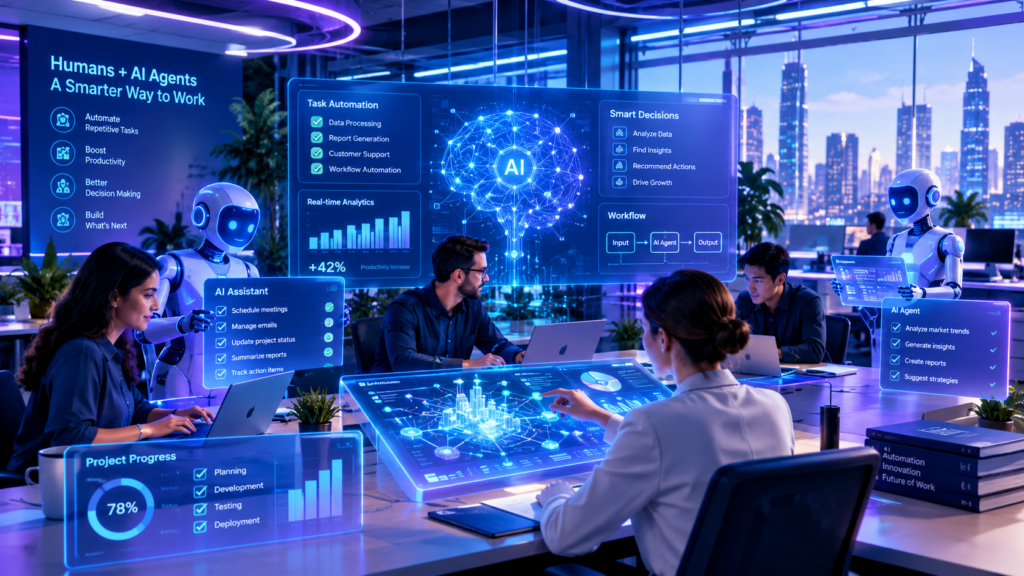
1. Artificial Intelligence Agents Will Automate Repetitive Tasks
One of the biggest impacts of Artificial Intelligence agents will be reducing repetitive manual work.
Employees spend significant time on tasks such as:
- Data entry
- Report creation
- Scheduling meetings
- Email management
- Document processing
Artificial Intelligence agents can handle these activities automatically, allowing employees to focus on creative thinking, strategy, and problem-solving.
For businesses, this means improved efficiency and reduced operational costs.
2. AI Agents Will Create an AI-Powered Workforce
The workplace of the future will not be humans versus AI. Instead, it will be humans working together with AI-powered assistants.
Employees will use Artificial Intelligence agents as digital coworkers that can:
- Analyze information
- Generate reports
- Research topics
- Manage workflows
- Provide recommendations
For example, a marketing professional could use an Artificial Intelligence agent to analyze customer behavior, identify trends, create campaign ideas, and measure performance.
This collaboration between humans and AI will create a more productive workforce.
3. AI Agents Will Improve Business Productivity
Artificial Intelligence agents can work continuously without breaks, helping organizations complete tasks faster.
Businesses can use AI agents for:
Customer Support
AI agents can provide instant responses, solve common issues, and improve customer experiences.
Sales Operations
Artificial Intelligence agents can analyze leads, personalize communication, and support sales teams.
Human Resources
Artificial Intelligence agents can assist with recruitment, employee onboarding, and workplace management.
IT Operations
Artificial Intelligence agents can monitor systems, identify problems, and automate technical processes.
By improving workflows across departments, Artificial Intelligence agents will become essential tools for business productivity.
4. Artificial Intelligence Agents Will Transform Decision-Making
Modern businesses generate huge amounts of data every day. Human teams often struggle to analyze all available information quickly.
Artificial Intelligence agents can process large datasets and provide valuable insights.
They can help businesses:
- Predict market trends
- Identify customer behavior patterns
- Analyze business performance
- Recommend strategic actions
This will allow companies to make faster and more informed decisions.
5. AI Agents Will Change Employee Roles
As Artificial Intelligence agents handle more routine activities, job roles will continue evolving.
Future employees will need skills focused on:
- Creativity
- Critical thinking
- AI collaboration
- Problem-solving
- Strategic decision-making
Instead of replacing all jobs, Artificial Intelligence agents will change how people work.
Employees who learn how to effectively use AI tools will have a significant advantage in the future workplace.
6. Enterprise AI Agents Will Drive Digital Transformation
Large organizations are already exploring enterprise Artificial Intelligence agents to improve operations.
Companies can deploy AI agents for:
- Business process automation
- Knowledge management
- Data analysis
- Customer experience improvement
- Internal communication
Enterprise AI adoption will become a major part of digital transformation strategies.
Benefits of AI Agents for Businesses
Businesses adopting Artificial Intelligence agents can experience several advantages:
Increased Productivity
AI agents complete tasks faster and allow employees to focus on higher-value activities.
Reduced Costs
Automation reduces the time and resources required for repetitive processes.
Better Customer Experiences
AI agents provide faster and personalized customer support.
Improved Accuracy
AI systems can reduce human errors in data processing and analysis.
24/7 Operations
Artificial Intelligence agents can support customers and business processes continuously.
Challenges of AI Agents Adoption
Although Artificial Intelligence agents offer many benefits, businesses must address several challenges.
Data Security
Companies need strong security measures to protect sensitive information.
Human Oversight
AI decisions should be monitored to ensure accuracy and reliability.
Employee Training
Workers need proper training to collaborate effectively with AI systems.
Ethical Considerations
Organizations must ensure responsible AI usage.
The Future of Work With AI Agents
The future workplace will be a combination of human creativity and artificial intelligence.
Artificial Intelligence agents will not simply replace existing tools; they will become intelligent partners that help employees work smarter.
From automating daily tasks to improving business decisions, AI agents will reshape industries and redefine productivity.
Companies that successfully integrate Artificial Intelligence agents into their workflows will gain a competitive advantage in the evolving digital economy.
Conclusion
Artificial Intelligence agents and the future of work represent one of the biggest technological transformations of the modern workplace.
As AI technology continues advancing, businesses and employees will move toward a new model where humans and intelligent systems work together.
The organizations that embrace Artificial Intelligence agents early will be better prepared for the future of work, innovation, and digital transformation.