Search engine optimization (SEO) is essential for bloggers who want to attract organic traffic, reach new readers, and grow their websites. However, researching keywords, optimizing articles, analyzing competitors, and tracking rankings can take a significant amount of time.
This is where AI SEO tools can help.
The best AI SEO tools for bloggers in 2026 use artificial intelligence to simplify keyword research, improve content quality, identify optimization opportunities, and automate repetitive SEO tasks. These tools can help beginners and experienced bloggers work more efficiently without losing sight of what readers actually need.
In this guide, we will explore some of the most useful AI-powered SEO tools, their key features, advantages, limitations, and how bloggers can use them to improve their SEO workflow.
Table of Contents
What Are AI SEO Tools?
AI SEO tools are software applications that use artificial intelligence, machine learning, natural language processing, or related technologies to support search engine optimization.
They can help bloggers discover relevant keywords, analyze search results, identify content gaps, optimize headings, and monitor website performance.
Instead of manually completing every SEO task, bloggers can use AI to speed up research and analysis while making better-informed decisions.
Why Bloggers Need AI SEO Tools in 2026
AI SEO tools can be useful for several reasons:
- Faster keyword research: Discover relevant search terms and related topics.
- Better content optimization: Identify missing subtopics and opportunities to improve article structure.
- Competitor analysis: Study competing pages and understand what they cover.
- Time savings: Reduce repetitive tasks such as generating content briefs and reviewing on-page elements.
- Content planning: Organize related articles into topic clusters.
- Performance improvement: Use search and analytics data to identify pages that may need updating.
AI tools do not guarantee higher rankings. Their value depends on the quality of the data, the usefulness of the content, and how effectively bloggers apply their recommendations.
Best AI SEO Tools for Bloggers in 2026
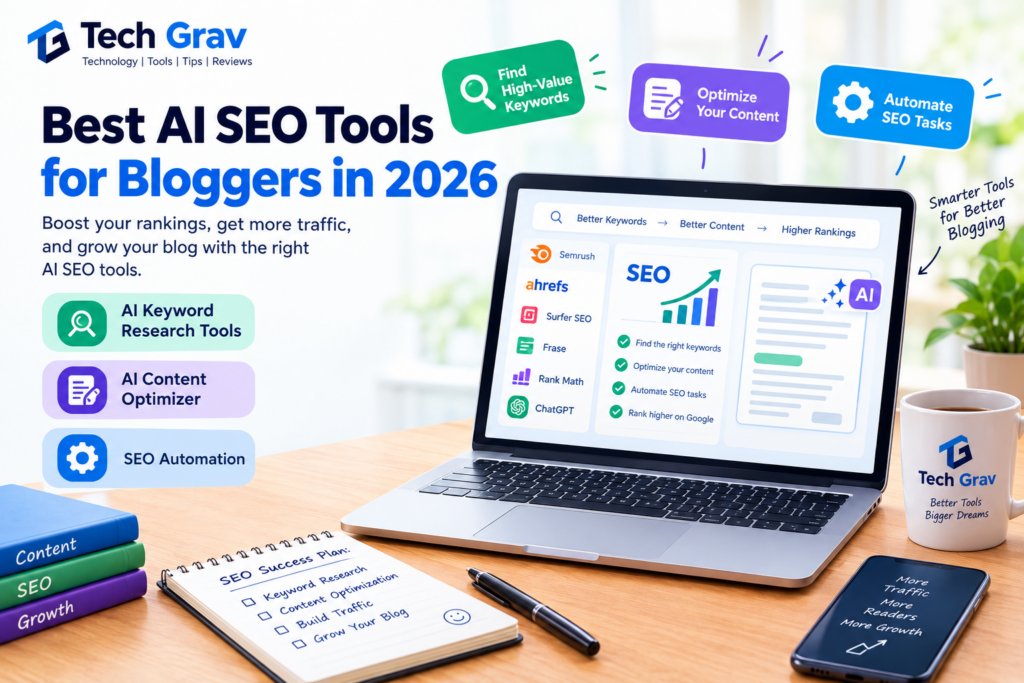
The following tools offer different capabilities, from keyword discovery and content optimization to technical SEO and automation. Some use AI directly, while others combine AI features with traditional SEO data.
1. Semrush
Best for: Keyword research, competitor analysis, and SEO planning.
Semrush is a comprehensive SEO platform that helps bloggers research keywords, analyze competing websites, monitor rankings, and identify opportunities for organic growth.
Its keyword and content tools can support bloggers who want to build an SEO strategy around relevant search demand rather than publishing articles based on guesswork.
Key features:
- Keyword research and search-volume estimates.
- Keyword difficulty and search-intent analysis.
- Competitor keyword research.
- Site audits and ranking tracking.
- AI-assisted content and SEO features in supported products or plans.
How bloggers can use it:
Start by researching a primary keyword, reviewing related search terms, and evaluating competing pages. Use those findings to create an article outline that answers the searcher’s main questions.
Pros:
- Broad SEO research capabilities.
- Useful for planning content clusters.
- Combines keyword research with competitive analysis.
Cons:
- Many advanced features require a paid subscription.
- Keyword metrics are estimates and should be interpreted carefully.
2. Ahrefs
Best for: Keyword research, backlink analysis, and competitor research.
Ahrefs is a popular SEO platform that helps bloggers explore keyword opportunities, analyze backlinks, inspect competing pages, and discover content that attracts organic traffic.
Its keyword research tools are particularly useful when deciding whether a topic is realistic for a website to target.
Key features:
- Keyword search-volume estimates.
- Keyword difficulty scores.
- Competitor content analysis.
- Backlink research.
- Website and organic performance analysis.
How bloggers can use it:
Enter a potential keyword and review its difficulty, related terms, and ranking pages. Look for specific topics where you can produce more useful, accurate, or comprehensive content than competing pages.
Pros:
- Strong backlink and competitor analysis.
- Useful for finding keyword variations.
- Helps assess the competitive landscape.
Cons:
- Advanced research generally requires a paid plan.
- A low keyword difficulty score does not guarantee easy rankings.
3. Surfer SEO
Best for: On-page content optimization.
Surfer SEO focuses on helping writers optimize content by analyzing competing search results and identifying relevant topics, terms, and structural recommendations.
It can be helpful when an article is already drafted and you want to review its topical coverage before publishing.
Key features:
- Content optimization recommendations.
- Article content scoring.
- Topic and keyword suggestions.
- Content brief creation.
- Content planning and auditing features, depending on the plan.
How bloggers can use it:
Prepare your article draft, analyze it with the available content editor, and review suggestions for missing subtopics or unclear sections. Make changes only when they improve usefulness and relevance.
Pros:
- Provides structured optimization guidance.
- Useful for editorial workflows.
- Helps identify content gaps.
Cons:
- Some features require a subscription.
- Following every recommendation mechanically can lead to unnatural writing.
4. Frase
Best for: SEO content briefs, research, and article outlines.
Frase helps content creators research topics, examine search results, organize questions, and prepare content briefs.
It can be particularly useful for bloggers who need a repeatable process for planning multiple articles.
Key features:
- Search-result research.
- AI-assisted content briefs.
- Article outlines and optimization suggestions.
- Topic and question discovery.
- Content planning features.
How bloggers can use it:
Research a target topic, identify the questions readers commonly ask, and create an outline that addresses those questions in a logical order.
Pros:
- Useful for planning articles before writing.
- Helps structure content around search intent.
- Can streamline research and briefing.
Cons:
- Paid features may be necessary for regular use.
- Search-result analysis should be supplemented with original research.
5. Rank Math SEO
Best for: WordPress on-page SEO.
Rank Math is a WordPress SEO plugin that helps bloggers manage important on-page SEO settings directly from the WordPress dashboard.
Its available features depend on the plugin version and plan. Supported AI features can assist with content-related workflows, while traditional plugin functions help manage metadata, sitemaps, schema, and other SEO settings.
Key features:
- SEO title and meta description management.
- XML sitemap functionality.
- Schema markup options.
- On-page SEO checks.
- AI-assisted content features in supported plans.
How bloggers can use it:
Set an appropriate SEO title and meta description, check that the target keyword fits naturally into the article, and confirm that the page is configured correctly for indexing.
Pros:
- Integrates with WordPress.
- Provides several SEO management features in one plugin.
- Useful for on-page optimization.
Cons:
- Some advanced features require a paid plan.
- Installing multiple SEO plugins can create duplicate functionality or conflicts.
6. Google Search Console
Best for: Monitoring real Google Search performance.
Google Search Console is an essential tool for bloggers who want to understand how their pages perform in Google Search. It is not primarily an AI writing tool, but its search performance data can guide AI-assisted SEO decisions.
Key features:
- Search queries and impressions.
- Clicks and click-through rate.
- Average search position.
- Indexing and page experience reports.
- Sitemap submission and monitoring.
How bloggers can use it:
Identify articles that receive impressions but relatively few clicks, pages that are gaining traction for relevant queries, and content that may need updating.
You can then use AI to help generate title variations, develop new supporting sections, or organize a content refresh plan. Validate changes against actual performance over time.
Pros:
- Free first-party Google Search data.
- Helps identify real content opportunities.
- Essential for tracking organic search performance.
Cons:
- Does not provide a complete competitor keyword database.
- Some reports have data limitations and delays.
7. ChatGPT
Best for: SEO brainstorming, content briefs, and editorial assistance.
ChatGPT can support many stages of a blogging workflow, including keyword clustering, search-intent analysis, outline development, title brainstorming, FAQ drafting, and content editing.
It is best used as an assistant for research and writing rather than as a replacement for reliable keyword metrics.
Key features:
- Generate article outlines and content briefs.
- Group related keywords into topic clusters.
- Suggest relevant subheadings and FAQs.
- Improve readability and article structure.
- Create SEO content-update checklists.
Example prompt:
“Create an SEO content brief for the keyword ‘AI tools for bloggers.’ Include search intent, related keyword variations, suggested H2 and H3 headings, reader questions, and useful examples. Do not invent search-volume or keyword-difficulty figures.”
Pros:
- Flexible for research and editorial planning.
- Useful for creating repeatable workflows.
- Can help simplify complex SEO tasks.
Cons:
- May generate inaccurate claims or unsupported keyword metrics.
- Does not replace dedicated SEO datasets.
- Content requires human review and fact-checking.
8. SE Ranking
Best for: Rank tracking and SEO research.
SE Ranking provides SEO research and monitoring features that can help bloggers track keyword positions, analyze competing pages, and audit websites.
AI-related capabilities and availability vary by product and plan.
Key features:
- Keyword research.
- Rank tracking.
- Competitor analysis.
- Website audits.
- Content optimization and AI-assisted features where available.
How bloggers can use it:
Monitor important keywords over time and investigate pages whose rankings have declined. Combine that information with Search Console data to prioritize content updates.
Pros:
- Combines several SEO monitoring functions.
- Useful for ongoing SEO campaigns.
- Can support content performance reviews.
Cons:
- Most advanced features are subscription-based.
- Ranking estimates may differ between tools and locations.
Comparison of the Best AI SEO Tools
| Tool | Best use | Free access |
|---|---|---|
| Semrush | Keyword and competitor research | Limited free tools may be available |
| Ahrefs | Keyword and backlink analysis | Limited free tools may be available |
| Surfer SEO | On-page content optimization | Check current plan |
| Frase | Content briefs and research | Check current plan |
| Rank Math SEO | WordPress on-page SEO | Core plugin has a free version |
| Google Search Console | Real Google Search performance | Free |
| ChatGPT | SEO planning and editorial assistance | Free access with applicable limits |
| SE Ranking | Rank tracking and SEO research | Check current plan |
Note: Features, free-tier limits, and prices can change. Confirm current availability on each tool’s official website before choosing a subscription.
How to Use AI Keyword Research Tools
AI keyword research tools can help bloggers discover related queries, group similar keywords, and organize content ideas. However, actual search-volume and difficulty data should come from a reliable keyword research source.
Step 1: Choose a Topic
Start with a subject relevant to your website. For example, a technology blog could research AI writing tools, AI productivity software, or AI automation.
Step 2: Find Keyword Variations
Use an SEO platform to discover related keywords, question-based queries, and more specific search phrases.
Step 3: Evaluate Search Demand and Difficulty
Review monthly search-volume estimates, keyword difficulty, search intent, and the websites currently ranking for each query.
Do not assume that a longer keyword automatically has low competition. Examine the actual search results before selecting your target.
Step 4: Group Related Keywords
Group keywords that share the same search intent into one article. Create separate articles when the searches require meaningfully different answers.
Step 5: Build a Content Plan
Prioritize topics that are relevant to your audience and that your website can cover with useful, original content.
What Is an AI Content Optimizer?
An AI content optimizer analyzes a draft and suggests ways to improve its relevance, structure, readability, and coverage of a topic.
Depending on the tool, it may suggest related terms, identify missing subtopics, review headings, or compare your article with competing pages.
How to Optimize a Blog Post With AI
- Choose one primary keyword and identify the search intent.
- Research related keywords and questions.
- Create a logical outline with descriptive headings.
- Write an original article that answers the reader’s questions.
- Use an optimizer to identify relevant missing information.
- Check facts, examples, links, and technical details.
- Improve the title and meta description.
- Review the published page’s performance in Google Search Console.
Avoid keyword stuffing or adding irrelevant terms simply to improve a content score. The purpose of optimization is to make an article more helpful, not to satisfy a software score.
How SEO Automation Can Save Bloggers Time
SEO automation means using software to handle repetitive SEO tasks with less manual effort.
Automation can help bloggers maintain a consistent workflow, monitor website issues, and identify opportunities that need attention.
Useful SEO Tasks to Automate
1. Rank tracking: Schedule regular checks for important keywords.
2. Website audits: Monitor technical problems such as broken links, missing metadata, or crawlability issues.
3. Content performance reports: Use Search Console data to review clicks, impressions, and query trends.
4. Content refresh reminders: Create a schedule to review older articles and update outdated information.
5. Editorial planning: Use templates or AI workflows to prepare content briefs and organize article ideas.
6. Internal linking reviews: Identify relevant pages that could link to newer articles.
Automation should support review rather than publish unverified changes automatically. Keep human approval for important content edits, redirects, canonical tags, and other changes that could affect indexing.
Best AI SEO Workflow for a WordPress Blog
For a WordPress website, an effective workflow can be simple and affordable.
Step 1: Research Keywords
Use Google Search Console to understand existing search performance and a keyword research platform to discover new opportunities.
Step 2: Create a Content Brief
Use ChatGPT or a content research tool to organize the search intent, questions, related topics, and proposed headings.
Step 3: Write Useful Content
Create an article with original explanations, practical examples, relevant evidence, and clear answers to readers’ questions.
Step 4: Optimize the Page
Use one WordPress SEO plugin to manage titles, meta descriptions, sitemaps, and other relevant settings. An additional content optimizer is optional.
Step 5: Publish and Monitor
Check indexing in Google Search Console and monitor impressions, clicks, and search queries.
Step 6: Improve Based on Evidence
Refresh articles when the data and reader needs justify it. Avoid changing content merely because an AI tool recommends adding more keywords.
Common Mistakes to Avoid When Using AI SEO Tools
1. Trusting Unverified Keyword Metrics
AI-generated search-volume or keyword-difficulty numbers may be inaccurate. Verify metrics using an SEO platform before making major content decisions.
2. Publishing Generic AI Content
Content that repeats common information without adding value is unlikely to differentiate your blog. Include original examples, demonstrations, experience, or useful comparisons.
3. Over-Optimizing Keywords
Repeatedly inserting the same phrase can make an article difficult to read. Use natural language and cover the topic comprehensively.
4. Ignoring Search Intent
An article targeting a tool-comparison query should compare relevant options. A tutorial query usually requires clear, practical steps.
5. Installing Too Many SEO Plugins
Multiple plugins may duplicate features or create conflicts. Select one main SEO plugin and add other tools only when they provide a distinct benefit.
6. Expecting Instant Rankings
SEO results depend on many factors, including competition, content quality, site accessibility, links, and search demand. AI tools can improve your workflow, but they cannot guarantee rankings.
Frequently Asked Questions (FAQs)
1. What are the best AI SEO tools for bloggers in 2026?
Semrush and Ahrefs are useful for keyword and competitor research; Surfer SEO and Frase can assist with content optimization; Rank Math supports WordPress SEO; Google Search Console provides search performance data; and ChatGPT can help with content planning and editorial tasks.
2. Are there free AI keyword research tools?
Yes. Google Search Console and selected free tools from SEO platforms can help you discover opportunities. Google Keyword Planner can also provide search-demand estimates, although its advertising competition metric is not the same as organic keyword difficulty.
3. What is an AI content optimizer?
An AI content optimizer evaluates a draft and suggests improvements to topical coverage, structure, related terms, and readability. Its recommendations should be reviewed for relevance and accuracy.
4. Can AI SEO tools improve Google rankings?
They can support better research, content planning, technical monitoring, and optimization. However, using an AI SEO tool does not automatically improve rankings. Results depend on the quality and relevance of the work.
5. What is SEO automation?
SEO automation uses software to handle repetitive activities such as rank tracking, website audits, reporting, and content-review reminders.
6. Can beginners use AI SEO tools?
Yes. Beginners can start with Google Search Console, a WordPress SEO plugin, and an AI assistant for planning and editing. They can add paid keyword research or optimization tools as their needs grow.
7. Should bloggers use AI to write entire articles?
AI can assist with research, outlines, drafting, and editing. Bloggers should review every article, verify factual claims, add original value, and ensure that the finished content genuinely helps readers.
Conclusion
The best AI SEO tools for bloggers in 2026 can make keyword research, content optimization, and routine SEO tasks more manageable. Platforms such as Semrush and Ahrefs support research, Surfer SEO and Frase assist with content planning, Rank Math helps with WordPress SEO, and Google Search Console provides valuable performance data.
For bloggers starting on a limited budget, begin with free tools and focus on publishing useful, well-researched articles. Add paid tools only when their features solve a clear problem in your workflow.
Ultimately, successful SEO is not about using the largest number of AI tools. It is about understanding your audience, selecting relevant keywords, creating original content, and improving your website based on reliable evidence.