
Future of AI in 2030: Predictions, Trends & Technologies
Artificial intelligence (AI) is transforming the way people work, learn, communicate, and solve problems. From AI chatbots and image generators to intelligent assistants and autonomous systems, this technology is becoming an increasingly important part of everyday life.
But what will artificial intelligence look like in 2030?
Over the next few years, AI could become more capable, more personalized, and more deeply integrated into businesses, schools, hospitals, homes, and transportation systems. AI agents may handle complex workflows, robots may perform more practical tasks, and AI-powered tools may help people make better-informed decisions.
However, the future is not guaranteed. Progress will depend on technological breakthroughs, costs, regulation, safety, and how people choose to use these systems.
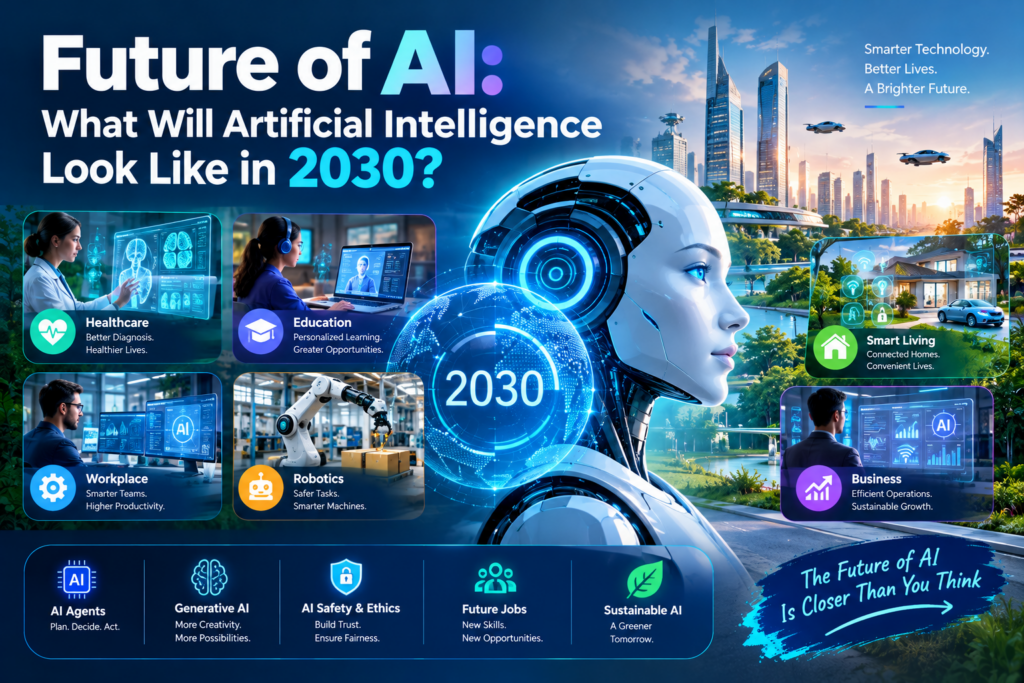
In this article, we’ll explore the future of AI in 2030, the most important trends to watch, how AI could change different industries, and what these developments may mean for jobs, businesses, and society.
Table of Contents
1. AI Agents Will Become More Advanced
One of the biggest developments expected in the future of AI is the growth of AI agents. Unlike traditional chatbots that primarily answer questions, AI agents can be designed to plan and perform multiple steps toward a goal.
By 2030, AI agents could become more common in everyday business and personal workflows.
For example, an AI agent might help a business organize customer requests, prepare reports, schedule meetings, and update records across connected applications, subject to permissions and human oversight.
Potential applications include:
- Automating repetitive office tasks.
- Supporting customer service operations.
- Managing schedules and business workflows.
- Assisting with software development.
- Researching information and summarizing findings.
However, reliable execution, privacy, security, and error prevention will remain important challenges.
2. AI Will Transform the Workplace
AI is already assisting people with writing, research, data analysis, programming, and administrative work. By 2030, these capabilities could become more deeply integrated into everyday business software.
Rather than using separate tools for every task, employees may increasingly work alongside AI assistants that understand their instructions and help complete connected workflows.
How AI Could Change Work
| Current Work | Possible AI Development by 2030 |
|---|---|
| Manual data entry | More intelligent document processing |
| Basic customer support | AI-assisted and agent-based support |
| Report preparation | Automated analysis and report drafts |
| Software development | AI-assisted coding and testing |
| Marketing content | Personalized content generation |
| Scheduling and administration | More connected workflow automation |
AI will not affect every occupation in the same way. Some tasks may become highly automated, while other jobs may change rather than disappear.
The key skill will be learning how to use AI effectively while developing human strengths such as judgment, creativity, communication, and leadership.
3. Healthcare Will Become More AI-Powered
Healthcare is another area where AI could make a major difference by 2030.
AI systems can already assist medical professionals with tasks such as analyzing medical images, organizing health information, and identifying patterns in research data.
Future improvements could support:
- Earlier identification of certain diseases.
- More personalized treatment planning.
- Faster analysis of medical images.
- Assistance with administrative documentation.
- Drug discovery and biomedical research.
- Remote patient monitoring.
For example, an AI system could help a radiologist flag a potentially important finding in a medical scan. The qualified healthcare professional would still need to interpret the findings and make clinical decisions.
AI could improve access and efficiency, but accuracy, patient privacy, fairness, and clinical oversight will remain essential.
4. AI Will Change Education and Learning
By 2030, AI could make personalized learning more accessible to students around the world.
Traditional classrooms often require teachers to support students with different learning speeds and needs. AI-powered learning tools can provide additional explanations, practice questions, feedback, and revision support.
Possible Benefits of AI in Education
- Personalized lessons based on learning progress.
- AI tutors that explain difficult concepts.
- Automatic generation of quizzes and practice exercises.
- Translation and language-learning assistance.
- Support for students with different learning needs.
- Faster preparation of teaching materials.
Imagine a student preparing for an examination who receives a customized revision plan, practices questions at the appropriate difficulty level, and gets explanations of mistakes.
Teachers will continue to play a vital role in motivation, social development, critical thinking, and classroom guidance. AI is most useful when it supports education rather than replacing meaningful human interaction.
5. Robotics and AI Will Work Together
The combination of AI and robotics could make machines more capable of performing tasks in physical environments.
Traditional industrial robots generally work within carefully controlled conditions. Advances in AI may help robots interpret their surroundings, understand instructions, and adapt to a wider range of situations.
Potential applications by 2030 include:
- Warehouse sorting and logistics.
- Manufacturing and quality inspection.
- Agricultural monitoring.
- Assistance with selected household tasks.
- Support for elderly people and people with disabilities.
- Inspection of hazardous environments.
Nevertheless, human-level flexibility in unpredictable real-world environments remains difficult. Hardware costs, reliability, safety, and maintenance will influence how quickly robots become widespread.
6. AI Will Make Businesses More Efficient
Businesses will likely continue adopting AI to reduce repetitive work and improve decision-making.
Small businesses may use AI for customer communications, content creation, sales support, and workflow automation. Larger organizations may apply it to logistics, software development, forecasting, and complex business operations.
Examples of Business AI in 2030
- AI systems that coordinate connected business workflows.
- More personalized customer experiences.
- Faster analysis of sales and operational data.
- AI-assisted inventory and supply chain planning.
- Automated document processing.
- Intelligent cybersecurity monitoring.
These developments could help companies save time and use resources more effectively. However, benefits will depend on the quality of implementation, the reliability of data, and the total cost of deploying and maintaining AI systems.
7. Generative AI Will Become More Powerful
Generative AI creates new content, including text, images, audio, video, and software code.
By 2030, creative tools may become more integrated, allowing users to move from an idea to a complete draft of a video, presentation, marketing campaign, or software prototype with fewer manual steps.
For example, a content creator might use AI to develop a script, generate visual concepts, produce voice-over drafts, and prepare subtitles within a connected workflow.
What This Means for Creators
- Faster content production.
- More accessible design and video editing.
- Personalized marketing materials.
- Interactive educational content.
- New forms of entertainment.
- Lower barriers to experimenting with creative ideas.
Human creativity will remain valuable for originality, storytelling, taste, and cultural understanding. Creators will also need to consider copyright, consent, misinformation, and disclosure when using AI-generated content.
8. Smart Homes and Everyday Life Will Become More Intelligent
AI may become more closely integrated into devices people already use, including smartphones, computers, vehicles, and home appliances.
Future assistants could help coordinate calendars, manage household energy usage, organize information, and control compatible devices.
For example, a smart home system might learn a household’s preferred lighting schedule and adjust heating or cooling based on occupancy and user settings.
Potential developments include:
- More conversational digital assistants.
- Smarter home energy management.
- AI-powered accessibility features.
- Personalized digital experiences.
- Improved voice translation and communication.
- More proactive assistance with routine tasks.
The extent of these changes will depend on affordability, interoperability, energy requirements, and users’ willingness to share data with connected systems.
9. Will AI Replace Jobs by 2030?
One of the most important questions about the future of AI concerns employment.
AI will likely automate some tasks, transform others, and create demand for new skills and roles. The impact will vary by occupation, industry, region, and how quickly businesses adopt the technology.
Jobs involving predictable digital tasks may face significant changes. Work requiring physical adaptability, complex human interaction, accountability, or specialized judgment may be affected differently.
Skills That Could Become More Valuable
| Skill | Why It Matters |
|---|---|
| AI literacy | Helps people use AI tools effectively |
| Critical thinking | Supports checking AI outputs and reasoning |
| Creativity | Helps develop original ideas and solutions |
| Communication | Remains essential for collaboration |
| Data analysis | Helps interpret information and make decisions |
| Adaptability | Supports learning as technology changes |
| Cybersecurity awareness | Helps protect systems and information |
Instead of focusing only on whether AI will replace jobs, people should consider which parts of their work could change and how they can prepare.
10. AI Safety, Privacy, and Regulation Will Matter More
As AI systems become more capable, responsible development and deployment will become increasingly important.
Companies and governments will need to address challenges involving data privacy, cybersecurity, bias, misinformation, copyright, and accountability.
Important priorities include:
- Protecting sensitive personal and business information.
- Testing AI systems for accuracy and reliability.
- Reducing unfair or discriminatory outcomes.
- Preventing unauthorized access and misuse.
- Maintaining human oversight in high-impact decisions.
- Establishing clear accountability for AI-assisted actions.
The future of AI will depend not only on what the technology can do, but also on whether people can trust it.
11. AI Predictions for 2030: What Could the Future Look Like?
The following table summarizes plausible developments, not guaranteed outcomes.
| Technology | Possible Development by 2030 |
|---|---|
| AI agents | More multi-step task automation |
| Healthcare AI | Wider use of decision-support tools |
| Education AI | More personalized learning assistance |
| Robotics | Broader use in selected real-world tasks |
| Business automation | More connected AI workflows |
| Generative AI | More integrated text, image, audio, and video tools |
| Smart devices | More context-aware digital assistance |
| Cybersecurity | Increased use of AI for detection and response |
The pace of progress will depend on technical capabilities, cost, regulation, public trust, and practical performance in real-world settings.
12. How to Prepare for the Future of AI
You do not need to be a programmer or technology expert to prepare for an AI-powered future.
Here are seven practical steps:
- Learn the basics of AI. Understand what AI can do and where it can make mistakes.
- Experiment with AI tools. Explore writing assistants, research tools, image generators, and productivity applications.
- Develop critical thinking. Verify important information rather than accepting every AI response.
- Improve digital skills. Learn about data, automation, cybersecurity, and digital collaboration.
- Build human strengths. Practice creativity, communication, problem-solving, and teamwork.
- Stay adaptable. Keep learning as tools and workplace expectations evolve.
- Use AI responsibly. Respect privacy, intellectual property, and applicable rules.
AI Tools For students, creators, professionals, and entrepreneurs, learning to use AI can be a practical investment in future readiness.
Conclusion: What Will AI Look Like in 2030?
The future of AI in 2030 could bring more intelligent assistants, advanced automation, personalized education, AI-supported healthcare, capable robots, and new ways to create digital content.
These developments may help individuals and companies work more efficiently, solve difficult problems, and access capabilities that were previously expensive or time-consuming.
However, progress will not be automatic. Technical limitations, employment disruption, privacy concerns, security risks, and the need for human accountability will shape how AI develops.
The most useful approach is to prepare for change without assuming that every prediction will come true.
The future will not be shaped by AI alone. It will be shaped by how people choose to build, govern, and use it.
For Tech Grav readers, the opportunity is clear: start learning about AI today, experiment with useful tools, and develop the skills needed to thrive in a changing digital world.


Pingback: Best Free AI Video Generators in 2026 - Techgrav
Pingback: How Generative AI is Transforming Business Operations in 2026 - Techgrav
An agent that schedules meetings and updates records across connected applications needs more than permission to act; it needs a clear way to undo mistakes. A wrong chatbot answer can stay in one conversation, while a wrong record update could feed into reports or trigger another workflow. For the 2030 workplace you describe, I would judge agents partly by how easily employees can trace and reverse their actions, not just how many tasks they complete.
Rick Owens — это бунтарский бренд, основанный в 1994 году с антигламурной установкой и особым подходом на стыке мрачной эстетики и гранжа.
Рик Оуэнс известен драпировками, асимметричными формами и использованием плотной кожи наряду с минималистичным кроем и мрачными оттенками.
Марка сочетает роскошь и протест, создавая вещи для выбирает самовыражение и не боится выглядеть иначе нестандартно.
Rick Owens интернет магазин
На данный момент эта марка представляет собой уже не только гардероб, а целое мировоззрение, включающее мебельный дизайн, обувь и философию осознанного выбора.
Бренд служит авторитетным игроком в мире моды, определяет собственные тенденции и обладает культовой кругом ценителей.