
Introduction to AI Agents
Businesses have always looked for better ways to save time, reduce costs, and improve productivity. Earlier automation systems helped companies complete repetitive tasks, but they often depended on fixed rules and human supervision. Today, a new generation of artificial intelligence is changing how businesses operate.
AI agents automation is becoming the next step in business automation by enabling systems that can understand goals, analyze information, make decisions, and complete tasks with limited human involvement.
From customer service and marketing to finance, healthcare, manufacturing, and software development, companies in India and the USA are exploring AI agent technology to create smarter workflows.
Unlike traditional automation, AI agents do not simply follow instructions. They can evaluate situations, plan actions, use different tools, and continuously improve based on outcomes.
This article explains what are AI agents, how they work, their business applications, benefits, challenges, and why they are becoming an important part of the future of automation.
Table of Contents
What Are AI Agents?
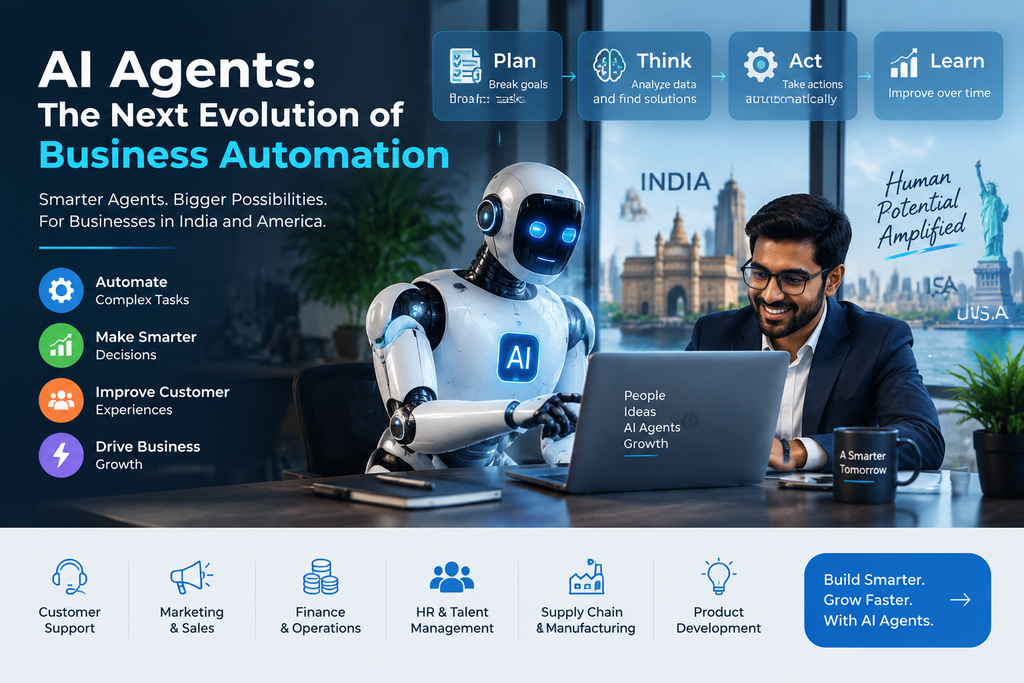
AI agents are software systems designed to perform tasks independently by understanding objectives, processing information, making decisions, and taking actions.
Simply put, an AI agent works like a digital employee that can handle specific responsibilities without requiring constant human instructions.
For example:
- A customer support AI agent can answer questions, check order details, and resolve basic issues.
- A sales AI agent can identify potential customers, prepare follow-up emails, and update CRM records.
- A finance AI agent can analyze expenses, prepare reports, and identify unusual transactions.
Unlike traditional software programs, AI agents can adapt to changing situations and choose the best action based on available information.
How AI Agents Work
Understanding how AI agents work requires looking at four main capabilities:
1. Understanding Goals
AI agents first understand the objective they need to achieve.
For example:
“Increase customer engagement for an online store.”
The AI agent identifies the required steps, such as analyzing customer behavior, creating personalized messages, and tracking results.
2. Collecting and Analyzing Information
AI agents can gather information from different sources, including:
- Business databases
- Customer records
- Websites
- Documents
- Analytics platforms
- Internal software systems
They use this information to understand situations and make better decisions.
3. Planning and Taking Action
After analyzing information, AI agents decide what actions are required.
For example, a sales AI agent may:
- Find potential customers
- Analyze their interests
- Create personalized communication
- Schedule follow-ups
- Update sales records
This ability to plan and execute tasks makes AI agents different from basic automation tools.
4. Learning and Improving
Modern AI agents can learn from previous interactions and outcomes.
If a specific approach produces better results, the system can adjust future actions accordingly.
This continuous improvement allows businesses to create more efficient processes over time.
AI Agents vs Automation: What Is the Difference?
Many businesses confuse AI agents with traditional automation.
Although both improve efficiency, they work differently.
| Traditional Automation | AI Agents |
| Follows predefined rules | Makes decisions based on context |
| Handles repetitive tasks | Handles complex workflows |
| Requires fixed instructions | Understands goals |
| Limited flexibility | Adapts to new situations |
| Usually works within one system | Can use multiple tools |
For example, traditional automation can automatically send an email after a customer purchase.
An AI agent can analyze customer behavior, decide the best message, personalize the email, and determine the right time to send it.
AI Agents vs Chatbots: Understanding the Difference
The difference between AI agents vs chatbots is becoming important as businesses adopt advanced AI solutions.
Traditional chatbots mainly focus on conversations. They answer questions based on programmed responses or available knowledge.
AI agents go further.
A chatbot may answer:
“Where is my order?”
An AI agent can:
- Check the order system
- Find the latest status
- Identify delivery problems
- Contact the logistics system
- Provide a solution
In simple terms:
Chatbots communicate. AI agents communicate, decide, and act.
How Businesses Are Using AI Agents in 2026
1. Customer Service Automation
Customer experience is one of the biggest areas where AI agents are creating value.
Businesses are using intelligent AI agents to:
- Respond to customer questions
- Resolve common complaints
- Process requests
- Recommend products
- Provide 24/7 assistance
For example, an e-commerce company can use an AI agent to manage customer inquiries, track shipments, and suggest related products based on customer preferences.
This reduces support workload while improving response time.
2. Sales and Marketing Automation
Sales teams spend significant time researching leads, sending emails, and updating customer information.
AI agents automation helps sales departments by handling repetitive activities.
A sales AI agent can:
- Identify potential customers
- Analyze customer interests
- Create personalized messages
- Schedule meetings
- Update CRM systems
Marketing teams can also use Generative AI agents to create campaign ideas, analyze audience behavior, and optimize content strategies.
3. Finance and Accounting Operations
Finance departments manage large amounts of data and documentation.
AI agent systems can help with:
- Invoice processing
- Expense analysis
- Financial reporting
- Fraud detection
- Budget monitoring
For example, an AI finance assistant can review hundreds of transactions and highlight unusual patterns that require human attention.
This helps finance professionals focus on analysis instead of manual checking.
4. Human Resources and Employee Support
HR teams handle employee questions, recruitment processes, and internal communication.
AI agents can support HR operations through:
- Resume analysis
- Interview scheduling
- Employee onboarding
- Training recommendations
- Policy assistance
An HR AI agent can answer employee questions about company policies and guide new employees through onboarding steps.
5. Manufacturing and Supply Chain Management
Manufacturing companies in India and the USA are exploring AI agents to improve operational efficiency.
AI agents can help with:
- Inventory planning
- Supply chain monitoring
- Equipment maintenance
- Production scheduling
- Demand forecasting
For example, an AI agent can analyze production data and predict possible equipment issues before they cause downtime.
6. Software Development and IT Operations
Technology teams are among the early adopters of AI agent technology.
AI agents can assist developers by:
- Writing code
- Finding errors
- Testing applications
- Managing documentation
- Monitoring systems
Instead of replacing developers, AI agents help teams build software faster and improve productivity.
What Are Autonomous AI Agents?
Autonomous AI agents are advanced systems that can complete tasks independently with minimal human guidance.
They can:
- Set goals
- Create action plans
- Use digital tools
- Make decisions
- Complete multi-step tasks
For example, an autonomous AI agent for business growth could analyze market trends, identify opportunities, create marketing recommendations, and prepare reports automatically.
However, businesses still need human oversight to ensure accuracy, security, and responsible decision-making.
Benefits of AI Agents Automation for Businesses
Increased Productivity
AI agents reduce manual work and allow employees to focus on higher-value activities.
Faster Decision-Making
AI systems analyze large amounts of information quickly and provide useful insights.
Improved Customer Experience
Businesses can provide faster and more personalized support.
Reduced Operational Costs
Automation reduces repetitive tasks and improves resource efficiency.
Better Scalability
Companies can handle increasing workloads without adding the same level of manual effort.
Challenges of AI Agent Adoption
Although AI agents offer major advantages, businesses must consider several challenges.
Data Privacy
AI agents often require access to business information. Strong security practices are essential.
Accuracy Issues
AI decisions should be reviewed, especially in important areas such as finance and healthcare.
Integration Problems
Connecting AI agents with existing business systems can require technical planning.
Employee Training
Teams need proper knowledge to use AI tools effectively.
Ethical Considerations
Businesses must create responsible AI policies to avoid misuse.
The Future of AI Agent Technology
The future of AI agent technology is moving toward more connected and intelligent business systems.
Companies are expected to adopt:
- AI-powered digital employees
- Multi-agent systems
- Industry-specific AI solutions
- Advanced workflow automation
- AI-driven business assistants
The next generation of business software will not only help employees complete tasks but will actively support planning, decision-making, and execution.
How Businesses Can Prepare for AI Agent Adoption
Companies planning to implement AI agent systems should follow a structured approach.
1. Identify Business Processes
Find tasks that consume time and require repeated manual effort.
2. Improve Data Quality
AI agents perform better when businesses have organized and accurate data.
3. Start With Small Projects
Test AI agents in specific areas before expanding across the organization.
4. Train Employees
Employees should understand how to collaborate with AI systems.
5. Monitor Performance
Measure improvements in productivity, cost savings, and customer satisfaction.
Frequently Asked Questions About AI Agents
1. What are AI agents?
AI agents are intelligent software systems that understand goals, analyze information, make decisions, and complete tasks automatically.
2. How do AI agents differ from traditional automation?
Traditional automation follows predefined rules, while AI agents can understand context, make decisions, and adapt to changing situations.
3. Are AI agents replacing human employees?
AI agents are designed to support employees by reducing repetitive work. Human judgment, creativity, and decision-making remain important.
4. What industries can benefit from AI agents?
Industries such as healthcare, finance, retail, manufacturing, IT, education, and customer service can benefit from AI agents.
5. What is an AI agent framework?
An AI agent framework is a development structure that helps businesses build, manage, and deploy AI agents using different models, tools, and workflows.
6. Are generative AI agents the future of business automation?
Generative AI agents are becoming an important part of business automation because they can create content, analyze information, and complete complex tasks.
Conclusion
AI agents represent a major shift in how businesses approach automation. Instead of simply automating individual tasks, companies can now build intelligent systems that understand objectives, make decisions, and complete complete workflows.
AI agents automation will play an important role in helping businesses in India and the USA improve productivity, customer experience, and operational efficiency.
However, successful adoption requires more than technology. Businesses need strong data management, employee training, security practices, and responsible AI strategies.
The future of automation is not only about machines doing more work. It is about creating smarter partnerships between humans and AI systems to build more efficient, innovative, and competitive businesses.


Pingback: SaaS Trends That Will Shape Business Technology in 2026 – Techgrav
Pingback: ChatGPT 6 Explained: Features, Capabilities & What’s New in OpenAI’s Latest AI Model - Techgrav
Pingback: How Artificial Intelligence Agents Will Change the Future of Work? - Techgrav
Pingback: Top 6 Artificial Intelligence Agents: The Next Generation of AI - Techgrav
Pingback: Why Agentic AI Is Trending in 2026: Benefits, Uses & Future - Techgrav
Pingback: AI Automation: How Companies Are Saving Time and Money - Techgrav